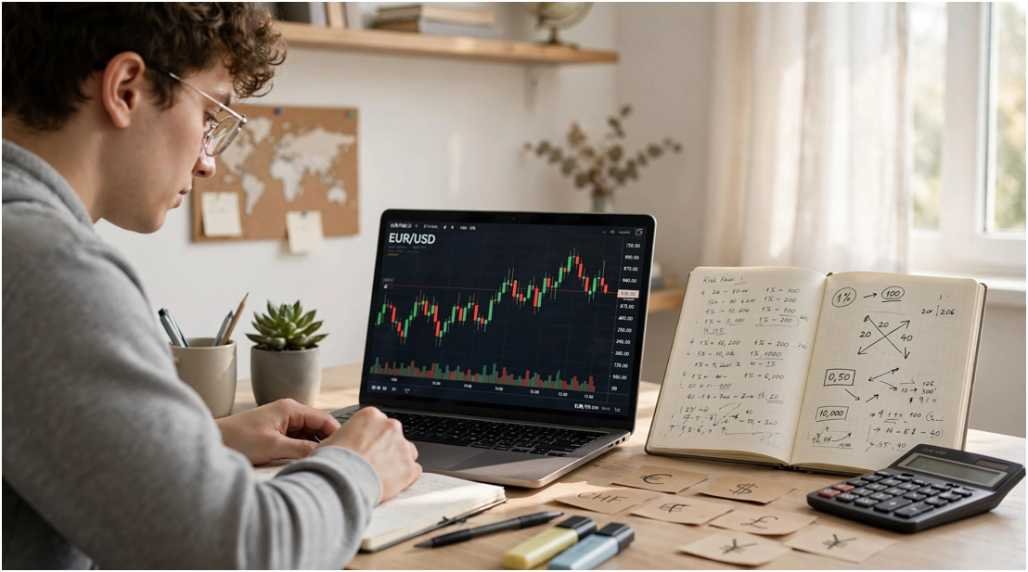
When I explain forex to new traders, I start with the same simple image: two currencies, a moving price, and buy and sell buttons. The difficult part is not clicking a button. It is understanding what the price represents and how leverage can magnify one mistake.
Anyone asking what is forex trading and how does it work for beginners should begin with one fact: forex trading involves buying one currency while simultaneously selling another.
Forex, or foreign exchange, operates through a global over-the-counter market rather than one central exchange. Banks, companies, governments, investment firms, and individual traders exchange currencies for commerce, hedging, investment, or speculation.
The Bank for International Settlements measured average daily foreign exchange turnover at $9.6 trillion in April 2025. That figure increased from $7.5 trillion in 2022. Forex Trading Actually Means
Every forex trade involves a currency pair. In EUR/USD, the euro is the base currency, while the U.S. dollar is the quote currency.
If EUR/USD is quoted at 1.1000, one euro costs 1.10 U.S. dollars. Buying the pair means you expect the euro to strengthen against the dollar. Selling the pair means you expect the euro to weaken.
Forex traders can therefore seek opportunities during both rising and falling markets. However, either position can lose money when the exchange rate moves in the opposite direction.
Suppose EUR/USD rises from 1.1000 to 1.1050. That represents a 50-pip move. A trader who bought the pair may gain, while someone who sold may lose.
The final dollar result depends on the position size, spread, entry price, and closing price. This is the first lesson I stress with beginners: predicting direction is only half the trade. Position size determines how much the prediction can help or hurt an account.
Forex Pips, Spreads, Lots, and Leverage Explained
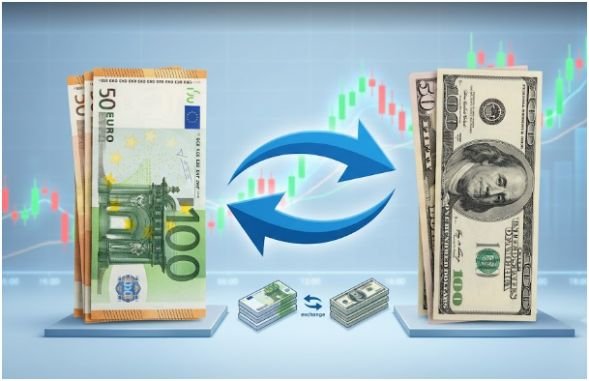
Four concepts explain most of the mechanics behind what is forex trading and how does it work for beginners: pips, spreads, lots, and leverage.
What Is a Pip?
A pip is a standard unit used to measure movement in a currency pair.
For many major pairs, one pip appears in the fourth decimal place. A move from 1.1051 to 1.1052 equals one pip. Currency pairs involving the Japanese yen usually measure pips at the second decimal place.
Pips help traders calculate potential profits, losses, stop distances, and position sizes.
What Is the Spread?
A forex broker normally displays two prices. The bid is the available selling price, while the ask is the available buying price.
The difference between them is the spread. It acts as a trading cost because a new position generally begins slightly below its break-even point.
Spreads can widen during major economic announcements, periods of low liquidity, or sudden market volatility. A low advertised spread is therefore not guaranteed for every trade.
What Is a Lot?
A lot measures the size of a forex position.
A standard lot represents 100,000 currency units. A mini lot represents 10,000 units, while a micro lot represents 1,000 units.
Smaller lot sizes give beginners more control over their exposure. They make it easier to match the position to a specific dollar-risk limit.
How Does Forex Leverage Work?
Leverage allows traders to control positions worth more than the cash deposited as margin. It increases market exposure, but it does not increase skill or improve the probability of success.
For U.S. retail forex accounts, National Futures Association rules generally require a 2% security deposit for specified major currencies and 5% for other currencies. These requirements correspond roughly to maximum leverage of 50:1 and 20:1.
A broker can impose stricter limits. exchange-rate movement can therefore produce a much larger percentage change in deposited funds. I treat available leverage as a ceiling, not a position-sizing target.
A Worked Risk Example Most Beginner Guides Skip
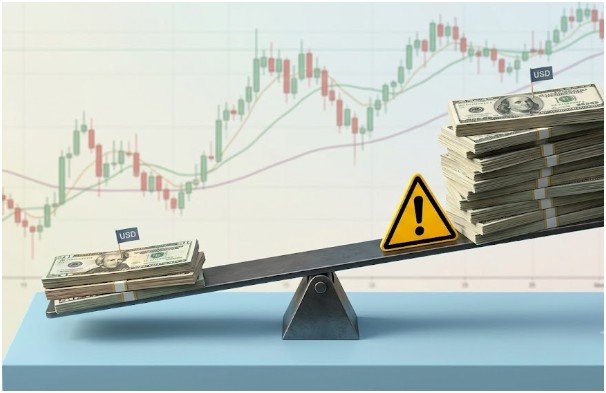
Assume a beginner has a $1,000 demo account and limits the risk on one EUR/USD trade to 1% of the account.
The maximum planned loss is therefore $10.
Now assume the trade needs a stop-loss placed 20 pips from the entry price. The allowed pip value can be calculated like this:
$10 account risk ÷ 20-pip stop = $0.50 per pip
On EUR/USD, one micro lot has an approximate pip value of $0.10. Five micro lots, or 5,000 currency units, would produce a pip value near $0.50.
A 20-pip loss would therefore equal approximately $10:
20 pips × $0.50 = $10
This result excludes possible spread changes, slippage, and execution differences.
Many beginners choose a large position first and then force the stop-loss to fit it. I reverse that order. Decide the acceptable dollar loss, choose a logical stop distance, and calculate the position size last.
That process does not guarantee a winning trade. It keeps one losing trade from causing disproportionate account damage.
How the Forex Market Operates
Forex activity moves through major financial centers across Asia, Europe, and North America. Trading in centers such as Tokyo, London, and New York creates near-continuous weekday activity.
The market is often described as operating 24 hours a day during the trading week. However, volume, spreads, and volatility change as different financial centers open and close. on and New York sessions overlap for several hours. This period often produces heavier activity in major U.S. dollar pairs.
More activity does not automatically make trading safer. Economic reports and central-bank announcements can produce sudden price moves, wider spreads, and slippage.
Interest-rate expectations, inflation, employment, economic growth, trade flows, and political risks can influence currency prices. For U.S. traders, Federal Reserve decisions and major American economic reports can strongly affect dollar pairs.
The market often reacts to how a report compares with expectations. A seemingly positive number can still weaken the dollar when traders expected an even stronger result.
How Beginners Can Start Forex Trading More Safely

When people ask what is forex trading and how does it work for beginners, I focus on building a controlled process before searching for profits.
Start by studying one or two major currency pairs. Learn their normal spreads, active trading hours, and reactions to scheduled economic reports.
Practice with a demo account before depositing real money. Use the demo to learn market orders, limit orders, stop-losses, profit targets, and position sizing.
A useful trading plan should define:
- The conditions required for an entry
- The maximum account risk per trade
- The location of the stop-loss
- The position-sizing method
- The intended exit or profit target
- The conditions that cancel the setup
Do not move a stop farther from the entry simply because the trade is losing. That action increases the original risk after the market has already challenged the idea.
U.S. beginners should also verify a broker before depositing money. The Commodity Futures Trading Commission advises traders to confirm registration and review disciplinary history.
Retail foreign exchange dealers in the United States generally must register with the CFTC and become NFA members. The NFA’s BASIC database provides membership details and information about regulatory actions. Risks Beginners Should Not Underestimate
Forex is not a savings account, guaranteed income source, or shortcut to financial independence.
The CFTC and state securities regulators warn that off-exchange retail forex trading is extremely risky and can also be used in fraudulent schemes. is the most visible danger, but it is not the only one. Slippage can create an exit price worse than expected. Spreads can widen without warning. Emotional overtrading can turn several manageable losses into a serious drawdown.
Retail forex is also an over-the-counter market. Depending on the account structure, the dealer may act as the counterparty rather than simply matching the trade on a centralized exchange.
Treat the following claims as warning signs:
- Guaranteed or fixed monthly returns
- Secret systems that supposedly never lose
- Pressure to deposit money immediately
- Requests for cryptocurrency payments
- Unverified account managers trading for clients
- Extra taxes or fees demanded before withdrawals
- Profit screenshots without audited records
A professional-looking app, website, or social-media account does not establish legitimacy. Verify the firm independently through official regulatory records.
Frequently Asked Questions
1. How much money does a beginner need to trade forex?
Minimum deposits vary, but beginners should practice on a demo and use only money they can afford to lose.
2. Is forex trading legal in the United States?
Yes, but retail traders should use properly registered firms and verify them through CFTC and NFA records.
3. Can beginners make money through forex trading?
Profits are possible, but losses remain possible; consistency requires disciplined sizing, tested rules, and realistic expectations.
4. What is forex trading and how does it work for beginners using a demo?
A demo account uses virtual funds to practice currency pairs, orders, stop-losses, and position sizing without risking cash.
The Final Pip: Learn First, Fund Later
I view forex as a risk-management exercise disguised as price prediction. Understanding pairs, pips, spreads, lots, leverage, and position sizing creates a stronger foundation than chasing trading signals.
Your next step is simple. Open a demo account with a properly regulated broker, select one major currency pair, and record 20 rule-based practice trades.
Do not judge the exercise only by virtual profit. Review whether every entry, stop, position size, and exit followed the written plan. A repeatable process is more valuable than one lucky result.