
Trading forex while working a full-time job can feel overwhelming, especially when your morning schedule is already packed. I’ve learned that spending more time watching charts doesn’t necessarily improve trading decisions. What matters is having a clear plan before the workday begins.
Understanding how to prepare for forex trading before work starts with a structured 20-minute routine focused on economic news, technical analysis, and risk management.
Instead of rushing into trades, I prefer identifying potential trading zones, setting alerts, and preparing for situations that may develop while I’m at work. This approach helps me separate market planning from professional responsibilities without sacrificing discipline.
Why Should You Prepare for Forex Trading Before Going to Work?
The forex market operates 24 hours a day during the trading week, but currency prices don’t move consistently throughout every session.
Economic announcements, central bank decisions, and changing liquidity can create unexpected volatility.
When working a traditional US 9-to-5 job, constantly monitoring currency charts isn’t practical.
I believe a consistent forex trading morning routine helps reduce impulsive decisions, establish realistic expectations, and identify opportunities that match a predefined trading strategy.
Most importantly, preparation helps me recognize when market conditions aren’t suitable for trading.
How Can You Prepare for Forex Trading in Just 20 Minutes?
I recommend dividing your morning preparation into three phases. Each phase has a specific purpose, allowing you to analyze the market without getting distracted by unnecessary information.
Minutes 0–5: How Do You Check Forex News Before Work?
I begin by reviewing the day’s economic calendar before opening any trading charts.
Websites such as Forex Factory provide information about scheduled economic events and their expected market impact.
I pay particular attention to high-impact announcements, commonly marked with red folder icons.
Important US economic releases include the Consumer Price Index (CPI), Nonfarm Payrolls (NFP), Federal Reserve interest rate decisions, and employment reports.
These announcements can cause sudden price movements, wider spreads, and unfavorable order execution.
I identify the exact release times, confirm the calendar’s time zone, and establish no-trade windows around important announcements.
If major news is scheduled while I’m working, I avoid placing new orders that could trigger during unpredictable market conditions.
Minutes 5–15: How Do You Analyze Forex Charts Before Work?

Once I’ve checked economic conditions, I move to technical analysis.
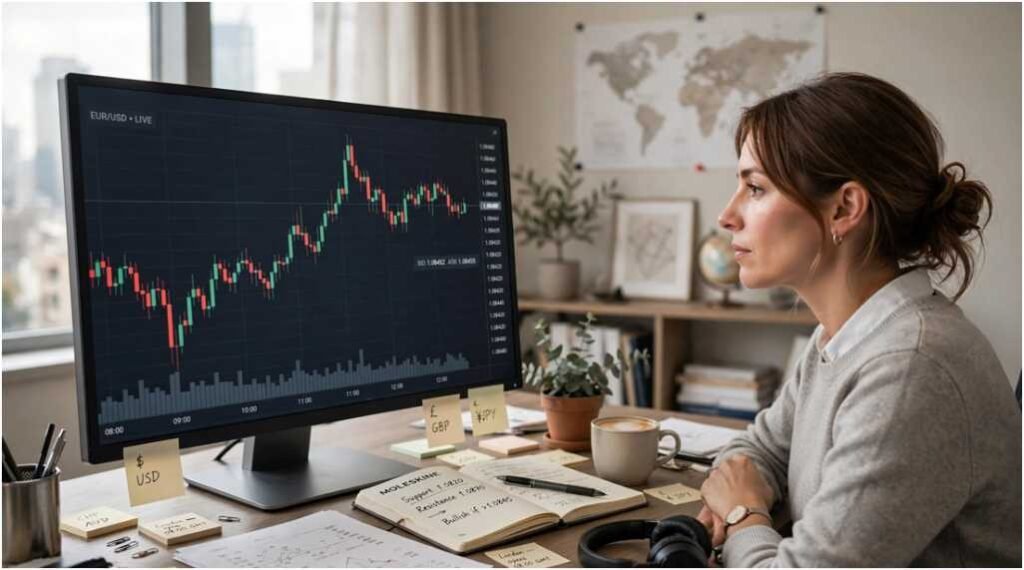
Rather than browsing numerous charts, I review a weekend watchlist containing two or three familiar currency pairs, such as EUR/USD, GBP/USD, and USD/JPY.
I examine daily and four-hour charts to determine whether the market is trending, consolidating, or approaching an important reversal zone.
Next, I identify nearby support and resistance levels, along with relevant supply and demand zones.
I also look for recognizable price action patterns that match my established strategy.
My objective isn’t to predict every market movement. It’s to identify areas where a potential setup might develop.
If the market doesn’t offer a clear opportunity, I leave the chart unchanged and continue with my day.
Minutes 15–20: How Do You Set Forex Alerts and Pending Orders?
The final five minutes focus on preparing for possible market movements without requiring continuous monitoring.
I use TradingView price alerts to receive notifications when a currency pair approaches an important level.
When my trading strategy supports automated entries, I may consider pending limit or stop orders.
Limit orders specify an acceptable execution price, while stop-entry orders can trigger an entry after price reaches a specified level. The exact behavior depends on the broker’s order rules.
Before submitting an order, I review my planned stop-loss, take-profit target, position size, and overall risk exposure.
Pending orders don’t guarantee execution, and stop-loss orders may experience slippage during volatile conditions.
Once my preparation is complete, I close the trading platform and shift my attention to work.
What Is the Best Time to Trade Forex Before a 9-to-5 Job in the USA?
The best trading time depends on your location, preferred currency pairs, and working hours.
For traders following Eastern Time, the London forex session is already active during the early morning.
The New York session generally begins around 8 AM Eastern Time, creating an overlap with London trading hours.
However, session relationships can temporarily change because the United States and United Kingdom adjust their clocks on different dates.
If you live in California, New York, Texas, or another US location, I recommend comparing your local schedule with market-session activity.
I focus on liquidity and economic announcements rather than assuming that a particular trading hour will always be profitable.
How Can You Manage Forex Trading Risk While Working Full-Time?

Risk management becomes especially important when traders cannot continuously supervise open positions.
I establish my maximum planned loss before considering any trade.
For example, risking 0.5% of a $5,000 account represents a $25 risk budget, assuming execution occurs as planned.
This is an illustrative limit, not a universally safe recommendation. Actual losses can exceed expectations because of slippage, gaps, or other execution risks.
I also use a forex position sizing calculator to match trade size with the planned stop-loss distance.
The Commodity Futures Trading Commission warns US retail traders about leverage and the substantial risks associated with over-the-counter forex trading.
For this reason, I avoid increasing positions simply because a trade appears promising.
What Mistakes Should You Avoid When Trading Forex Before Work?
One of the biggest mistakes is chasing market momentum when prices suddenly move before leaving for work.
I prefer missing a trade rather than entering without proper analysis.
Another mistake is frequently checking MetaTrader 4 or MetaTrader 5 during office hours. This behavior can distract from professional responsibilities and encourage emotional decisions.
I also avoid revenge trading, excessive leverage, and placing pending orders without considering scheduled economic announcements.
A set-and-forget trading approach doesn’t mean ignoring risk. It means using an appropriate trading plan while recognizing that alerts and automated orders cannot eliminate unexpected losses.
What Should Be on Your Before-Work Forex Trading Checklist?

When practicing how to prepare for forex trading before work, I focus on confirming that every important decision has been addressed.
First, I review the economic calendar and identify major announcements. Next, I examine my weekend watchlist, assess daily and four-hour market structure, and mark nearby trading zones.
I then calculate position size, review stop-loss and take-profit levels, and decide whether alerts or pending orders are appropriate.
Creating a quiet, organized workspace also helps me avoid distractions while trading forex at home, allowing me to concentrate on market analysis and make decisions without unnecessary interruptions.
Finally, I close the charts and avoid unnecessary monitoring during work.
This simple forex pre-trading checklist helps maintain consistency without creating pressure to trade every morning.
Frequently Asked Questions (FAQs)
1. Can I Trade Forex Before My 9-to-5 Job?
Yes. Forex markets operate throughout the trading week, allowing US traders to analyze currency pairs before starting work. However, trading opportunities depend on market conditions, time zones, and individual strategies.
2. Is 20 Minutes Enough for a Forex Trading Morning Routine?
Twenty minutes may be sufficient for experienced traders following an established plan. Beginners often need additional time to learn technical analysis, understand trading risks, and practice with demo accounts.
3. Which Forex Timeframe Is Best for Full-Time Workers?
Daily and four-hour charts may suit people who cannot monitor markets continuously. These timeframes involve fewer chart reviews but still carry significant market and overnight risks.
4. Can I Leave Forex Trades Open While Working?
Yes, but open positions remain exposed to market volatility. Pending orders, stop-loss levels, and take-profit targets can support trade management, although they don’t guarantee specific execution prices or prevent every loss.
Conclusion
I’ve found that balancing forex trading with a full-time job becomes more manageable when preparation takes priority over constant market monitoring.
A 20-minute routine covering economic news, technical analysis, risk calculations, and price alerts can help create a more organized trading process.
Learning how to prepare for forex trading before work isn’t about finding opportunities every morning. It’s about building consistent habits, protecting your attention during professional responsibilities, and understanding when market conditions justify staying out.
Start with a realistic routine, review your decisions in a trading journal, and remember that disciplined risk management matters more than the number of trades you place.