A profitable trade can reinforce a bad decision just as easily as a losing trade can punish a good one. That uncomfortable reality explains why some traders repeat damaging behaviors without realizing their discipline is slipping.
Learning how to recognize unhealthy trading habits begins with examining your decisions rather than your account balance. Revenge trading, excessive risk-taking, emotional exits, and constant strategy changes often develop gradually.
I believe the most revealing question isn’t whether a trade made money. It’s whether I would make the same decision again under identical conditions, knowing the outcome could be different.
Seven Warning Signs Your Trading Behavior Needs Attention
1. You Trade Immediately After Losing Money
Revenge trading happens when recovering a loss becomes more important than identifying a valid opportunity.
Imagine losing $150 on EUR/USD and immediately opening another position with twice your normal risk. Your objective has shifted from following a strategy to recovering money.
The warning signs include emotional urgency, larger positions, and skipping entry confirmation.
A useful safeguard is a predetermined cooling-off period after significant losses.
2. You Constantly Change Your Stop-Loss
A stop-loss should reflect a documented trading plan, not momentary discomfort.
Moving it farther away because you cannot accept a loss increases financial exposure. Tightening it impulsively can also cause unnecessary exits during normal market fluctuations.
Not every stop adjustment is inappropriate. A trailing stop or revised exit based on predefined technical conditions may be legitimate.
The difference is whether the adjustment follows documented rules or responds to fear.
3. You Take Trades Without Clear Setups
Overtrading often develops when traders confuse constant activity with productivity.
Opening positions during uncertain market conditions, chasing sudden price movements, or trading because you’re bored are common examples.
Research discussed by the National Bureau of Economic Research highlights earlier findings that households trading more frequently tended to earn lower net returns.
Although that evidence primarily concerns individual stock investors rather than retail forex traders, it illustrates why additional transactions do not automatically improve performance.
4. Winning Streaks Make You Ignore Risk Limits
Several profitable trades can create an exaggerated sense of control.
A trader who normally risks 1% per position might suddenly risk 4% after a successful week, assuming recent results demonstrate exceptional skill.
However, short-term success cannot establish that a strategy will remain profitable.
The warning appears when confidence changes your position sizing, entry standards, or willingness to accept uncertainty.
Applying a 1-to-3 risk-reward ratio strategy can help traders define potential returns relative to their acceptable losses and maintain consistent risk parameters instead of increasing exposure after a winning streak.
5. You Constantly Monitor Open Positions
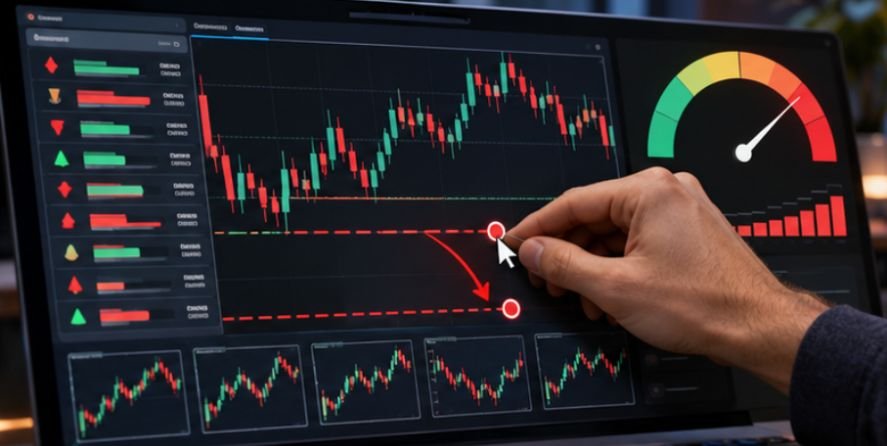
Watching every price movement may feel responsible, but excessive monitoring can encourage emotional interference.
You might close profitable positions prematurely, increase profit targets without justification, or repeatedly check your trading application during work.
Monitoring frequency should match your trading strategy.
A scalper may reasonably require continuous attention, while a swing trader using daily charts generally has less need for minute-by-minute monitoring.
6. You Abandon Strategies After Ordinary Losses
Strategy-hopping happens when traders repeatedly replace their methods without gathering enough evidence to evaluate them.
One week involves moving averages. The next focuses on Fibonacci retracements. Shortly afterward, an unfamiliar indicator becomes the preferred strategy.
Changing methods isn’t necessarily harmful. The problem arises when emotional disappointment replaces structured testing.
Before abandoning an approach, examine its sample size, market conditions, historical performance, and underlying assumptions.
7. Trading Starts Affecting Your Health and Relationships
Some of the most important warning signs appear outside trading platforms.
Persistent irritability, sleep disruption, difficulty concentrating, and withdrawal from family activities can indicate that trading-related stress is becoming unhealthy.
The American Psychological Association identifies irritability, fatigue, sleep difficulties, and physical tension among common stress-related symptoms.
These symptoms do not automatically establish a mental health condition. However, persistent interference with daily life deserves attention and potentially professional support.
How Can You Identify Bad Trading Patterns in Your Trade History?

How to recognize unhealthy trading habits becomes easier when you compare actual decisions against written trading rules.
Instead of relying on memory, review your most recent 20 completed trades.
Conduct a 20-Trade Behavior Audit
For each trade, record the setup, entry reason, planned risk, actual risk, stop-loss adjustments, emotional state, and outcome.
Then answer five questions:
- Did I enter only after my required confirmation appeared?
- Did I follow my planned position-sizing rules?
- Did I modify the stop-loss without a documented reason?
- Was I trying to recover money or chase momentum?
- Would I consider the decision acceptable if it lost money?
Calculate your rule-compliance rate:
Rule compliance = (Trades following all essential rules ÷ Total trades reviewed) × 100
For example, if 15 of 20 trades followed your rules, compliance equals 75%.
That doesn’t prove your strategy is profitable. It shows that one-quarter of your recent decisions violated at least one essential rule.
Repeat the audit periodically to identify whether behavior is improving.
Look for Patterns Around Wins and Losses
Examine whether mistakes occur immediately after losing streaks, unexpectedly large wins, or stressful economic announcements.
Understanding how interest rates affect financial markets can help traders assess how central bank decisions and changing economic expectations influence market volatility, particularly when reviewing trading behavior around major economic announcements.
Separate expected market losses from preventable mistakes.
Understanding drawdown in forex trading helps distinguish normal account declines from losses made worse by inconsistent risk management.
Why Do Traders Repeat Behaviors They Know Are Harmful?

Trading decisions are influenced by emotional rewards, perceived control, and fear of missing opportunities.
A lucky profit from an impulsive position may reinforce poor execution. Meanwhile, a properly planned losing trade can tempt someone to abandon an otherwise reasonable strategy.
This creates a dangerous mismatch between decision quality and immediate reward.
The Financial Industry Regulatory Authority provides investor education on day trading risks, underscoring the importance of understanding the demands and potential losses involved.
Recognizing that uncertainty is unavoidable helps traders evaluate their processes without expecting every decision to succeed.
How to Replace Harmful Trading Habits With Better Decisions
Start by identifying the trigger behind each recurring mistake.
If frustration causes impulsive entries, introduce a mandatory break. If boredom encourages overtrading, establish clearly defined trading windows.
Create a pre-trade checklist that confirms entry conditions, stop placement, acceptable risk, and upcoming economic releases.
Use platform alerts to reduce unnecessary chart monitoring. Consider trading smaller positions or practicing in a simulated account while correcting repeated rule violations.
Most importantly, measure disciplined execution separately from profits.
A well-executed loss can demonstrate progress, while an impulsive win may reveal a weakness that still needs correction.
Frequently Asked Questions
1. What is the most common unhealthy trading habit?
Overtrading is a frequently reported problem. It often involves entering unnecessary positions because of boredom, fear of missing out, or frustration after losses.
2. How do I know if my trading is becoming emotional?
Watch for impulsive entries, unexplained position-size increases, repeated stop-loss changes, and difficulty accepting losses. Compare these decisions against your written trading plan.
3. Can profitable traders develop unhealthy habits?
Yes. Profitable outcomes can reinforce reckless decisions. Consistent profitability alone doesn’t establish disciplined execution or sustainable risk management.
4. How long does it take to correct bad trading habits?
There is no universal timeline. Progress depends on the behavior, consistency of practice, and willingness to review mistakes. Focus on measurable rule compliance rather than arbitrary deadlines.
Discipline Shows Up Before the Results
The biggest danger in trading isn’t always a losing position. Sometimes, it’s a profitable trade that convinces you to repeat a reckless decision.
I’ve learned to judge trading behavior through preparation, risk limits, and consistency rather than individual outcomes. A losing trade doesn’t automatically mean the process failed, and a winning trade doesn’t guarantee the decision was sound.
If you’re learning how to recognize unhealthy trading habits, begin with your last 20 trades. Identify one recurring weakness and establish a measurable rule to address it.
Protecting your decision-making process is more valuable than chasing the next profitable trade.