When I compare forex markets, I start with the pair’s category. Knowing what are major minor and exotic currency pairs helps me estimate liquidity, spreads, volatility, news exposure, and margin before price moves.
Major pairs contain the U.S. dollar and another heavily traded currency. Minor pairs combine widely traded currencies without the dollar. Exotic pairs usually match a major currency with one from an emerging or smaller economy.
How Currency Pairs Work
Every forex quote compares two currencies. The first is the base currency, and the second is the quote currency.
Suppose EUR/USD trades at 1.1000. That price means one euro costs 1.10 U.S. dollars. Buying EUR/USD means buying euros while selling dollars.
Economic news from either region can therefore move the quote. U.S. interest-rate expectations may strengthen the dollar, while European inflation data may affect the euro.
Before comparing categories, I make sure I understand how to read a forex quote. Confusing the base and quote currencies can reverse a trader’s interpretation of direction and market exposure.
What Are Major Minor And Exotic Currency Pairs in Practice?

The three categories describe how currencies are combined and how actively each market trades. Major pairs normally have the greatest liquidity. Minor pairs provide exposure to non-dollar relationships. Exotic pairs involve less-traded currencies and often carry higher costs.
However, these groups are market conventions rather than fixed scientific classifications. Brokers and educational platforms sometimes categorize individual pairs differently.
I use the category as a starting point. I still examine the live spread, active session, margin requirement, financing cost, and economic calendar before considering a pair.
Major Currency Pairs: High Liquidity and Dollar Exposure
Major currency pairs combine the U.S. dollar with another widely traded currency. The conventional retail list includes:
- EUR/USD
- USD/JPY
- GBP/USD
- AUD/USD
- USD/CAD
- USD/CHF
- NZD/USD
These markets usually attract deep liquidity. More buyers and sellers can create tighter bid-ask spreads, faster execution, and more consistent pricing.
That does not make major pairs predictable or risk-free. They can move sharply after inflation reports, employment numbers, elections, or central-bank announcements.
The dollar’s influence explains why these pairs dominate forex activity. The 2025 Bank for International Settlements survey found the U.S. dollar on one side of 89.2% of global foreign-exchange trades. Global daily turnover reached roughly $9.5 trillion during the survey month.
Why EUR/USD Is a Common Beginner Benchmark
EUR/USD receives substantial institutional and retail participation. It also reacts to widely available economic information from the Federal Reserve, European Central Bank, and government statistical agencies.
The Bank of England’s April 2025 London survey recorded EUR/USD as the most traded pair in that market. Its average daily turnover reached approximately $1.01 trillion and represented 25% of London FX activity.
I still would not call EUR/USD safe. High liquidity may reduce trading friction, but it cannot remove leverage, slippage, or incorrect analysis.
Minor Currency Pairs: Dollar-Free Crosses
Minor pairs are also known as cross-currency pairs or crosses. They combine established global currencies without including the U.S. dollar.
Common examples include EUR/GBP, EUR/JPY, GBP/JPY, EUR/AUD, AUD/JPY, and CHF/JPY. Major and minor pairs are commonly separated by whether the dollar appears in the quote.
A cross lets me express a direct opinion about two non-dollar economies. EUR/GBP, for example, reflects the relative outlook for the eurozone and the United Kingdom.
Liquidity is usually lower than in leading major pairs. Spreads may widen when the pair’s home markets are closed or trading activity falls.
Some crosses can also move faster than beginners expect. GBP/JPY may respond to British economic data, Japanese monetary policy, bond yields, and global risk sentiment.
I therefore track both regional economic calendars. I also watch related dollar pairs because dealers may use them when pricing less-liquid crosses.
Exotic Currency Pairs: Wider Costs and Local Risk

Exotic pairs usually combine a major currency with one from an emerging, developing, or smaller economy.
Common examples include USD/MXN, USD/ZAR, USD/TRY, USD/INR, EUR/TRY, and USD/SGD.
These markets often have lower liquidity and wider spreads than major or minor pairs. Their prices may react strongly to elections, inflation shocks, capital controls, reserve changes, political instability, or unexpected central-bank action.
An exotic pair is not necessarily volatile every minute. Some currencies operate under managed exchange-rate systems.
The greater concern is uneven liquidity. A calm market can suddenly become expensive or difficult to exit when political or economic stress appears.
My Cost Check Before Considering an Exotic
I compare the spread with the pair’s normal price range and my planned stop-loss distance.
A wide spread can consume a significant part of a short-term target before the position becomes profitable. The actual cost also depends on trade size, pip value, and the broker’s pricing model.
I then examine overnight financing. Large interest-rate differences can create substantial rollover charges. Those charges may overwhelm a position held for several days.
The Overlooked Truth: “Major” Is a Convention
One overlooked point about what are major minor and exotic currency pairs is that these labels do not perfectly reflect changing global turnover.
Retail education usually presents the same seven conventional major pairs. However, the structure of the global market continues to evolve.
CME Group’s analysis of the 2025 BIS survey reported that renminbi turnover increased 56% between 2022 and 2025. Emerging-market currency activity also grew faster than activity in developed-market currencies.
That suggests the conventional seven-pair list may not always mirror current global trading activity. Currency controls, retail availability, broker access, liquidity structure, and historical convention all influence how a pair is classified.
I therefore treat “major” as shorthand for market structure rather than a permanent medal awarded to specific currencies.
Major vs Minor vs Exotic: What Changes?
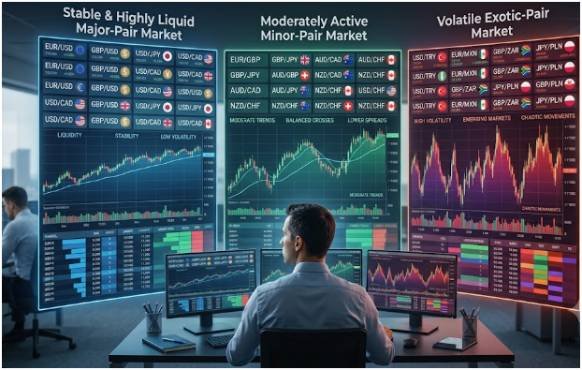
Major pairs normally provide the deepest liquidity, narrowest spreads, and greatest volume of research. They also react heavily to U.S. economic data because every major pair contains the dollar.
Minor pairs remove direct dollar exposure. However, they may have wider spreads and more complicated regional drivers.
Exotic pairs can provide exposure to distinct economic themes, interest-rate differences, or emerging markets. Their spreads, financing costs, margin requirements, and political risks are often higher.
The category can also affect U.S. retail margin. Current National Futures Association rules require a minimum 2% security deposit for transactions involving listed major currencies and 5% for other currency transactions. Dealers may impose higher requirements.
My Three-Question Pair Selection Filter
Before studying a possible entry, I ask three questions.
First, is the spread small compared with my planned stop and target? Trading costs can consume much of a short-term opportunity.
Second, can I explain the main drivers of both currencies? Understanding only one economy means understanding only half the trade.
Third, is the pair active during my available trading hours? Liquidity changes across the Asian, European, and North American sessions.
For beginners, this filter often favors one or two liquid major pairs. Following fewer markets makes their normal reactions, active hours, and economic drivers easier to recognize.
U.S. Risk Checks for Every Pair
U.S. retail forex is generally an off-exchange or over-the-counter market. The Commodity Futures Trading Commission warns that customers often trade directly against their dealer rather than through a central exchange.
I would verify the dealer’s registration, examine withdrawal terms, compare prices with independent sources, and review every risk disclosure.
The CFTC has also reported that approximately two-thirds of customers at registered OTC forex dealers lost money after fees and other expenses during the period it reviewed.
Knowing what are major minor and exotic currency pairs does not replace position sizing or risk management. Even a tight-spread major can cause a severe loss when leverage is excessive.
Frequently Asked Questions
1. What are major minor and exotic currency pairs for beginners?
Majors include USD, minors exclude USD, and exotics combine a major currency with a less-traded currency.
2. What is the difference between major and minor currency pairs?
Major pairs include the U.S. dollar, while minor pairs combine established currencies without it.
3. Which currency pairs usually have the lowest spreads?
Highly liquid major pairs, particularly EUR/USD, normally have the tightest spreads under standard market conditions.
4. Are exotic currency pairs suitable for beginners?
They are usually harder because spreads, financing costs, liquidity, and country-specific risks can be less predictable.
Pick the Pair, Not the Drama
Understanding what are major minor and exotic currency pairs gives me a quick way to judge trading cost, liquidity, and complexity.
Majors usually provide the clearest starting point. Minors offer targeted non-dollar exposure. Exotics demand deeper research, wider risk allowances, and stricter position sizing.
My next step would be practical rather than theoretical. I would compare one major, one minor, and one exotic pair on a demo platform.
Record each pair’s spread, margin requirement, active session, average movement, and reaction to economic news. The differences become obvious once the market starts moving.