A 5% movement in the U.S. dollar can turn a profitable international investment into a disappointing trade, even when the underlying asset performs well. Exchange rates influence purchasing power, corporate earnings, investment returns, and trading decisions.
Understanding how currency value changes affect trading strategies helps traders recognize opportunities while protecting their capital from unexpected market movements.
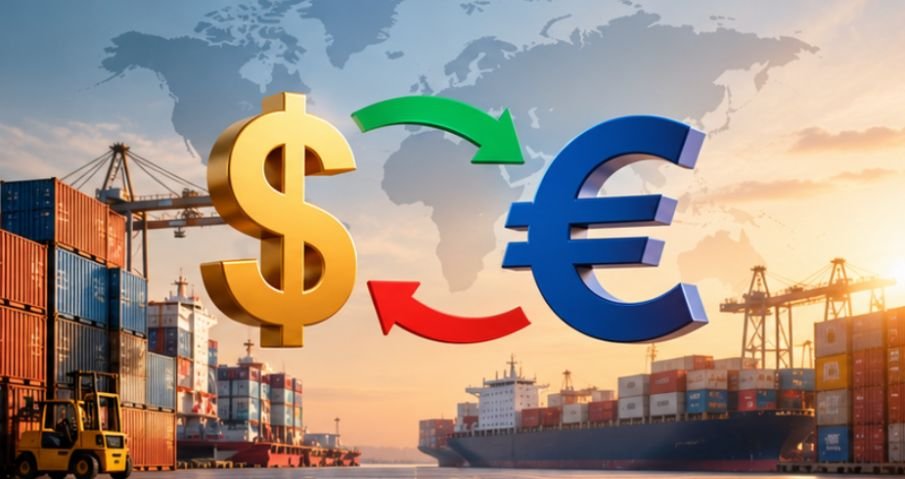
A stronger dollar may benefit American importers but create difficulties for exporters. A weaker dollar can reverse those advantages. For forex traders, stock investors, and international businesses, recognizing these relationships is essential to making informed financial decisions.
Why Currency Values Move and Why Traders Should Care
Currency values fluctuate because global investors continuously reassess economic conditions, interest rates, and financial risks.
Exchange rates represent the price of one currency relative to another. For example, if EUR/USD rises from 1.0800 to 1.1000, the euro has strengthened against the dollar.
Several economic forces influence these movements:
- Interest rates: Higher relative yields can attract foreign investment and increase currency demand.
- Inflation: Persistent inflation may weaken purchasing power and reduce confidence in a currency.
- Economic growth: Strong economic performance can attract international capital.
- Political uncertainty: Elections, trade disputes, and geopolitical tensions can increase exchange-rate volatility.
- Market sentiment: Investors may shift toward currencies perceived as safer during financial uncertainty.
The Federal Reserve explains that exchange-rate movements influence American economic activity and prices, making them an important part of monetary policy transmission. Traders therefore need to examine both technical price movements and the economic developments driving them.
Interest-rate differences are particularly important because they can influence capital flows and demand for individual currencies. Understanding how interest rates affect financial markets helps traders connect central-bank decisions with exchange-rate movements, bond yields, stock valuations, and broader investor sentiment.
How a Stronger U.S. Dollar Changes Trading Opportunities
Dollar appreciation means one dollar purchases more units of another currency. Although this strengthens American purchasing power abroad, its influence on financial markets varies considerably.
Import-Dependent Companies May Benefit
A stronger dollar can reduce the cost of foreign materials, products, and services. American retailers importing electronics, clothing, or manufacturing components may experience lower purchasing expenses when supplier prices remain unchanged in foreign currencies.
Traders evaluating these companies should examine whether lower import costs translate into improved profit margins.
However, currency benefits may be limited by shipping expenses, tariffs, supplier contracts, and competitive pricing.
Exporters Face Greater Pricing Pressure

Dollar appreciation can make American products more expensive for international customers. Consider a manufacturer selling equipment for $100,000.
If the dollar strengthens substantially against a customer’s currency, that customer may need more local currency to purchase the same equipment. This can reduce demand and pressure revenue. Investors may respond by reviewing export-oriented industries, including industrial machinery, agriculture, and aerospace.
International Investment Returns Can Decline
Currency appreciation also influences foreign investments held by American investors. Suppose an international stock gains 8% in its domestic market, but its currency depreciates 10% against the dollar.
The approximate dollar-denominated return becomes:
\[ (1.08 \times 0.90)-1=-2.8\% \]
Despite the stock’s positive local performance, the American investor experiences a 2.8% loss before fees and taxes. This demonstrates why currency exposure deserves attention alongside asset performance.
What Happens When the Dollar Weakens?
A declining dollar changes the balance between import costs, export competitiveness, and investment returns.
Export-Oriented Businesses May Gain an Advantage
American products can become more affordable for overseas buyers when the dollar depreciates. Manufacturers, agricultural producers, and certain technology exporters may benefit from improved international competitiveness.
The International Monetary Fund explains that exchange-rate movements can influence import and export demand, although pricing currencies and global supply chains affect the outcome.
Traders should avoid assuming every exporter benefits equally. Companies importing expensive components may face rising production costs.
Import Costs and Inflation Risks Increase
Dollar depreciation makes foreign-currency-priced goods more expensive for American buyers. Businesses relying on imported equipment, materials, or merchandise may experience shrinking margins.
Companies sometimes respond through price adjustments, supplier diversification, or currency hedging. For stock traders, the key question is whether businesses can pass additional expenses to customers without losing sales.
Foreign Assets Can Become More Attractive
A weaker dollar can increase the dollar value of international investments. For example, an American investor holding European shares may benefit from both rising stock prices and euro appreciation. However, favorable exchange-rate movements cannot guarantee positive investment returns.
Trading Strategies That Respond to Exchange-Rate Movements
Understanding currency movements is only useful when traders translate that knowledge into disciplined decisions. Different market conditions require different approaches.
1. Trend Following in Forex Markets
Trend-following traders attempt to benefit from sustained currency movements.
They may use moving averages, support and resistance levels, and market structure to identify directional opportunities.
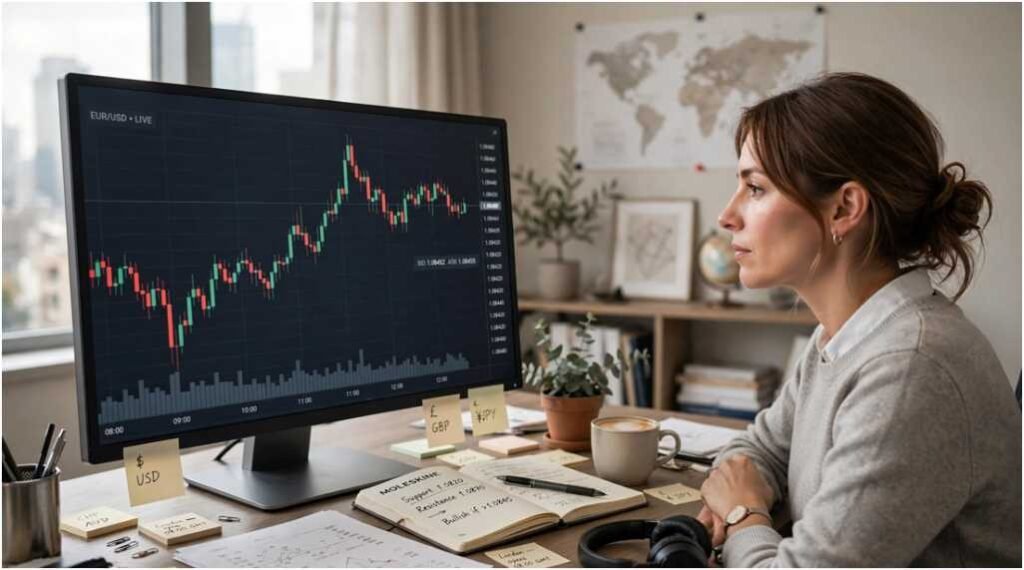
For example, consistently higher highs and higher lows in EUR/USD may suggest strengthening bullish momentum.
Traders should confirm the trend across multiple timeframes rather than relying on one indicator.
Reading price charts effectively can help forex traders distinguish sustained currency trends from short-term fluctuations. Learning how to read financial charts for beginners provides a foundation for interpreting candlestick patterns, support and resistance levels, and trading volume before making decisions based on exchange-rate movements.
2. Currency Carry Trading
Carry trading involves borrowing or funding a position in a lower-interest-rate currency and investing in a higher-yielding currency. Potential returns depend on interest-rate differences and exchange-rate movements.
The Bank for International Settlements reported in May 2026 that leveraged carry-trade positions can amplify currency responses to unexpected monetary tightening. A sudden appreciation of the funding currency can quickly eliminate accumulated interest income. Carry trading therefore requires careful evaluation of volatility, funding costs, and leverage.
3. Hedging Currency Exposure
Hedging helps businesses and investors reduce uncertainty from unfavorable currency movements.
Common instruments include:
- Forward contracts: Arrange a future currency exchange at an agreed rate.
- Currency futures: Standardized contracts traded through exchanges.
- Currency options: Provide rights to exchange currencies at specified rates, usually requiring a premium.
The International Trade Administration identifies forward contracts as a direct method American exporters can use to manage foreign-exchange exposure. Hedging can protect predictable cash flows, although it introduces expenses and may limit favorable exchange-rate benefits.
4. Diversifying Currency Exposure

Diversification reduces reliance on a single currency or economic region. Investors may combine domestic assets, foreign equities, international bonds, and currency-hedged funds.
However, diversification cannot eliminate all risks. During major financial disruptions, previously unrelated investments may decline together.
Managing currency exposure effectively also requires a portfolio-wide approach to risk and asset allocation. Learning how to manage your trading portfolio can help traders balance positions, diversify investments, and control exposure to market volatility without relying too heavily on a single currency or asset class.
Common Mistakes That Can Undermine Currency Strategies
One frequent mistake is assuming stronger currencies always produce better investments.
Currency appreciation may reflect attractive economic fundamentals, but it can also damage export competitiveness.
Another mistake is confusing interest-rate advantages with guaranteed profits. High-yielding currencies can depreciate sharply, overwhelming income from interest differences. Excessive leverage creates additional danger.
The Commodity Futures Trading Commission warns that leveraged retail forex positions can generate substantial losses and that most customers at registered over-the-counter forex dealers lose money.
Traders should also remember that exchange rates are influenced by expectations. Markets sometimes move opposite to seemingly positive economic announcements because favorable outcomes were already priced in.
Frequently Asked Questions
1. How do currency fluctuations affect forex trading profits?
Exchange-rate movements determine gains and losses on currency positions. Profitability also depends on trade direction, position size, leverage, spreads, and financing expenses.
2. Can a weaker dollar benefit stock investors?
Yes. Dollar depreciation may support exporters and increase the dollar value of foreign investments, although company fundamentals and broader market conditions remain important.
3. Which economic indicators influence currency trading?
Interest-rate decisions, inflation figures, employment reports, GDP growth, and central-bank communications frequently influence exchange rates.
4. What is the safest way to manage exchange-rate risk?
No strategy eliminates risk. Diversification, appropriate position sizing, carefully selected hedges, and avoiding excessive leverage can help limit financial exposure.
Make Currency Movements Part of Every Trading Decision
Currency fluctuations can change investment outcomes without changing the underlying quality of an asset. A profitable international company may become less attractive after unfavorable exchange-rate movements, while another business may benefit from shifting global purchasing power.
Successful traders look beyond whether the dollar is rising or falling. They investigate why the movement is occurring, which assets are exposed, and whether market prices already reflect those expectations.
Before entering an international trade, calculate the possible currency impact alongside the expected investment return. That simple habit can prevent avoidable losses and support more disciplined trading decisions.