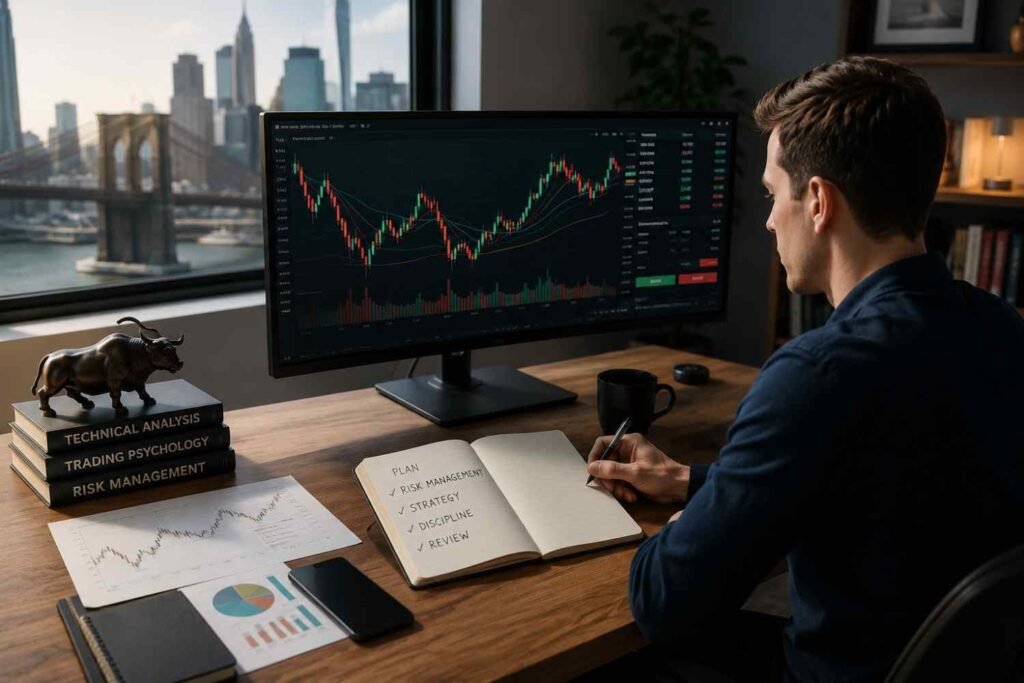

Balancing a full-time job, family responsibilities, and personal commitments makes learning forex trading challenging. I’ve noticed that many beginners believe they must spend hours watching currency charts to develop trading skills. However, a structured learning schedule can make the process much more manageable.
If you’re wondering how to learn forex trading with limited time each day, I recommend combining short study sessions, higher-timeframe chart analysis, and weekend preparation.
You don’t need to monitor every market movement. Instead, focus on understanding the fundamentals, practicing consistently, and developing disciplined habits.
Here’s how I would build a practical forex learning routine around a busy American lifestyle.
Can You Really Learn Forex Trading in 30 Minutes a Day?
Yes, 30 minutes of focused daily study can help you develop foundational forex knowledge. However, learning the basics doesn’t guarantee profitable trading.
I recommend dividing your daily session into three activities: learning concepts, practicing chart analysis, and reviewing your progress.
Beginners should first understand currency pairs, pips, spreads, leverage, margin, and stop-loss orders.
As your knowledge improves, you can explore strategies that require less frequent monitoring.
Consistency matters more than rushing through complicated trading techniques.
Why Is Swing Trading Worth Learning When You Have Limited Time?
Swing trading is one approach worth exploring when your schedule doesn’t allow continuous market monitoring.
Unlike scalping or intraday strategies that may require frequent decisions, swing trading generally involves holding positions for several days or longer.
How Can Daily and 4-Hour Charts Simplify Forex Analysis?

I recommend studying daily charts to understand broader market trends and four-hour charts to examine potential entry opportunities.
For example, suppose EUR/USD shows an upward trend on the daily chart. You could then examine the four-hour chart to see how price behaves near key support levels.
Higher-timeframe analysis may reduce the need for constant chart checking, although false signals and unexpected market movements remain possible.
Swing trading also carries overnight financing costs, weekend gap risks, and potential losses.
What Is the Best 30-Minute Daily Forex Trading Routine?
An effective daily forex learning routine should balance education, observation, and practice.
For beginners, I recommend spending 10 minutes studying one concept, 15 minutes practicing on historical charts or a demo account, and five minutes reviewing mistakes.
Once you understand trading mechanics, you can use a separate routine to evaluate potential trades.
The same disciplined approach is useful when exploring other financial markets, and these tips for trading ETFs successfully offer additional insights into researching investments, managing risk, and making informed trading decisions.
How Should You Review Forex Charts After Work?
Many forex charts use the New York trading-day close at approximately 5:00 p.m. Eastern Time.
I suggest reviewing completed daily candles when your schedule permits, rather than reacting to every short-term price movement.
An experienced trader might allocate five minutes to reviewing existing positions, 15 minutes to scanning selected currency pairs, and 10 minutes to checking alerts or planned orders.
Stop-loss adjustments and profit-taking should follow a predefined strategy, not an automatic daily habit.
Beginners can practice this process in a demo account without risking personal funds.
How Can You Follow a Four-Week Forex Learning Plan?
A structured forex trading study plan for beginners helps you avoid jumping between unrelated strategies.
Week 1: What Forex Trading Basics Should You Learn?

Start with currency pairs, exchange rates, spreads, pip values, leverage, and margin.
Explore major pairs such as EUR/USD, GBP/USD, and USD/JPY.
Your goal should be understanding how forex transactions work and why borrowing exposure through leverage increases risk.
Week 2: How Do You Learn to Read Forex Charts?
Study candlesticks, support and resistance, market trends, and basic price action.
To build a stronger understanding of chart-based trading, beginners can explore different price action trading strategies to learn how candlestick patterns, market structure, and key price levels can help identify potential trading opportunities.
Practice identifying potential trading zones on daily and four-hour charts.
Avoid memorizing dozens of indicators before understanding what price movements represent.
Week 3: How Can You Practice Forex Trading Without Real Money?
Use a demo account to practice placing orders, setting stop-loss levels, and calculating hypothetical position sizes.
Record your reasoning before every simulated trade.
Remember that demo results cannot fully represent live-market conditions, including execution differences and emotional pressure.
Week 4: How Do You Evaluate Your Forex Learning Progress?
Review your trading journal, identify recurring mistakes, and revisit difficult concepts.
I recommend assessing your understanding of market structure, risk management, and order execution instead of focusing exclusively on simulated profits.
How Can You Prepare for Forex Trading During the Weekend?
Weekend preparation can reduce weekday decision-making pressure.
For a more structured approach, I follow a weekend forex trading routine that includes reviewing market trends, identifying key price levels, checking upcoming economic events, and preparing trading scenarios for the week ahead.
I recommend setting aside approximately one or two hours on Sunday for deeper market research.
Review weekly and daily charts, identify major support and resistance zones, and prepare a watchlist of three to five liquid currency pairs.
You might monitor EUR/USD, GBP/USD, and AUD/USD rather than constantly switching between unfamiliar markets.
Check the upcoming US economic calendar for Consumer Price Index reports, employment releases, and Federal Reserve interest-rate announcements.
Plan hypothetical entry conditions, invalidation points, and risk limits before the trading week begins.
Markets can move unexpectedly after economic announcements, so preparation never eliminates risk.
Which Forex Trading Tools Save the Most Time?
Choosing a few practical tools can make learning and market observation more efficient.
How Do TradingView Price Alerts Help Busy Beginners?
TradingView allows users to configure alerts when prices reach specified levels.
Instead of continuously monitoring charts, you can receive notifications and review market conditions when your schedule permits.
An alert signals that a condition occurred; it doesn’t guarantee a profitable opportunity.
Can Pending Orders Reduce Forex Screen Time?
Pending orders instruct a trading platform to attempt execution when specified price conditions are met.
I recommend practicing these orders in a demo account before considering live execution.
Remember that orders may experience slippage, gaps, or other execution limitations.
Why Should You Use an Automated Trading Journal?
An automated journal can import available trading records and organize performance metrics.
However, I would still record the reasoning behind each simulated decision, since numerical results alone cannot explain behavioral mistakes.
What Forex Trading Mistakes Should Busy Beginners Avoid?

Understanding how to learn forex trading with limited time each day also means recognizing habits that can undermine your progress.
Avoid checking trading apps repeatedly during work, making rushed decisions, or forcing trades simply because you’ve allocated time for market analysis.
I also recommend reviewing major economic announcements before considering new positions. Unexpected volatility can quickly invalidate a trading setup.
Most importantly, don’t mistake a successful demo trade for proof that a strategy works consistently.
Frequently Asked Questions
1. Is 15 Minutes a Day Enough to Learn Forex Trading?
Yes. Fifteen minutes can help you study one concept, review a chart, or maintain a learning journal. More complex topics may require longer weekend sessions.
2. What Is the Best Forex Trading Strategy for Busy People?
Higher-timeframe swing trading may suit people who cannot monitor markets continuously. However, no strategy guarantees profitability, and every approach requires risk management.
3. Can I Learn Forex Trading for Free in the USA?
Yes. BabyPips offers introductory lessons, while charting platforms and demo accounts provide practice opportunities. US beginners can also consult official CFTC educational resources.
4. How Long Does It Take to Learn Forex Trading While Working Full Time?
You can develop foundational knowledge over several weeks of consistent study. Building advanced analytical skills and determining whether you’re prepared for live trading may take considerably longer.
Conclusion
I believe successful forex education begins with a manageable schedule, realistic expectations, and disciplined practice.
Learning how to learn forex trading with limited time each day becomes easier when you combine a 30-minute study routine, higher-timeframe analysis, weekend preparation, and reliable educational resources.
Start with forex fundamentals, practice in a demo environment, and use trading alerts to reduce unnecessary screen time.
Most importantly, prioritize understanding and capital protection over quick profits. Consistent learning can improve your knowledge, but financial markets always involve uncertainty.