Master What is Leverage in Forex Trading with Smart Risk Control

Welcome to your essential guide on navigating currency market exposure while keeping your trading account safe and growing.
Navigating the currency markets often feels like driving a tuned sports car, where knowing what is leverage in forex trading determines if we reach our goals or stall out early. We have all seen traders lured by big profit promises, only to realize exposure cuts both ways.
Risk management in forex trading is the single factor separating consistent survivors from those who blow up their balances in a few bad sessions. Before putting real dollars on the line, we need to master how borrowed capital impacts equity, margin, and emotional control.
How Leverage and Margin Work in Real Trades
Understanding market exposure begins with breaking down how borrowed purchasing power operates in daily transactions.
What is Leverage in Forex Trading and Ratio Basics
Leverage is the use of borrowed money from a broker to control a large currency position with a small amount of your own capital. It is shown as a ratio like 50:1 or 100:1, meaning a 2% margin lets you control $100,000 with just $2,000. Every time we open a trade, this ratio allows us to control a substantial position using only a tiny fraction of our equity.
Think of it as a security deposit on a property purchase. You put down a small amount of cash, and the broker facilitates access to the full asset value. If the exchange rate moves in your favor, you collect profits based on full trade value, but if the market swings against you, losses accrue just as rapidly.
Good-Faith Deposit and Account Cash Collateral
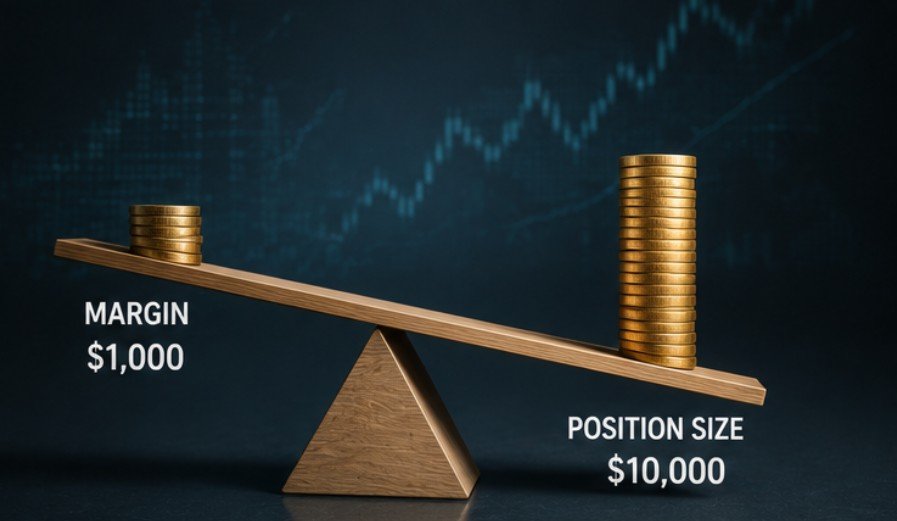
The relationship between your deposit and total market control is expressed as your required margin deposit.
Margin is the good-faith deposit or cash collateral you must keep in your account to open and keep a leveraged trade open. At 50:1, the required margin is 2%, meaning a $100,000 EUR/USD trade requires $2,000 in account margin. Lower leverage ratios like 20:1 require a 5% margin deposit, keeping your account far safer from normal market swings.
How Full Position Profits and Losses Accumulate
Calculating trade balance outcomes requires looking at the total size of your position rather than your account deposit alone.
Gains and losses are calculated based on the full size of the trade, not just your margin deposit. If you trade a standard $100,000 lot with a 50:1 leverage ratio and the price moves 1% in your favor, you gain $1,000, which is a 50% return on your $2,000 margin.
However, if the price drops 1%, you lose that same $1,000 instantly. This structural reality makes calculating exact dollar outcomes essential before placing any order.
Learning how to calculate risk to reward ratio helps us compare the amount of capital we could lose with the potential profit available from a trade. For example, risking $100 to pursue a $300 profit creates a 1:3 risk-to-reward ratio. This calculation helps determine whether a setup offers enough potential return to justify the risk created by leverage.
Risks and Regulatory Limits Every Trader Faces

Exploring trading risks helps us identify the exact tactical traps that destroy account balances when trading on margin.
The Double-Edged Sword of High Exposure
High leverage can make you big profits on winning trades, but it can also wipe out your account quickly on losing trades. When you trade with maximum exposure, even a minor market fluctuation can inflict devastating damage on your usable equity.
A minor 50-pip move against an over-leveraged account can erase half your balance in minutes. Beginners often focus on potential gains, forgetting that high exposure leaves zero room for error when prices temporarily spike against their direction.
Liquidation Risks Margin Calls and Stop-Outs
Brokers enforce automated safety cutoffs to prevent account balances from dropping into negative territory during high volatility.
If your losses eat up your margin, your broker can force your trades to close through a margin call or stop-out. If losses continue past required thresholds, the broker initiates an automatic liquidation, forcibly closing open positions at market price to protect their capital.
This turns floating paper losses into permanent account damage, making recovery extremely difficult for undercapitalized traders.
Regional Rules and Maximum Leverage Ceilings
Regulatory oversight provides a protective boundary designed to keep retail traders from over-exposing their capital balances.
Rules depend on where you live; for example, retail limits are capped at 50:1 for major pairs in the US and 30:1 in Australia and Europe. Minor and exotic pairs carry even lower limits, such as 20:1 in the United States, due to higher price volatility and lower liquidity.
These rules keep brokers from offering extreme ratios that quickly wipe out retail accounts during unexpected news events.
How to Apply What is Leverage in Forex Trading Safely
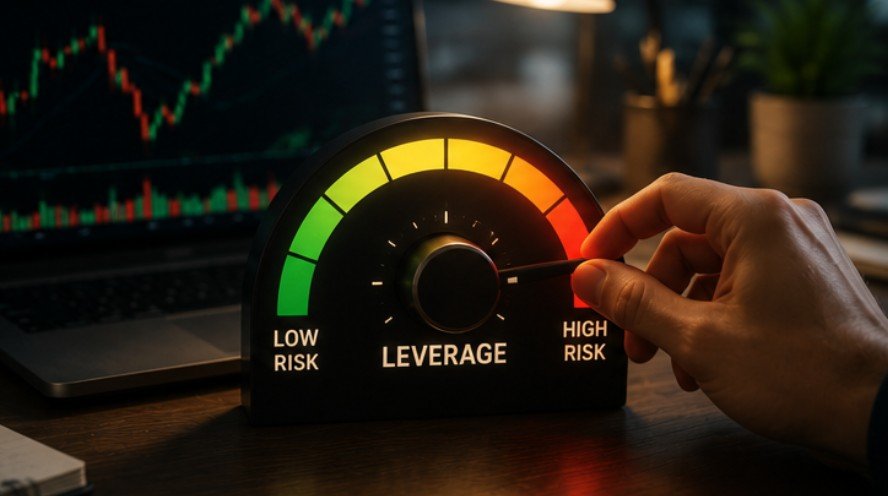
Applying controlled exposure in active markets requires a structured execution plan focused entirely on risk preservation.
Step one starts with calculating your exact dollar risk before opening any position. Instead of choosing a leverage ratio first, decide to risk no more than 1% to 2% of your total account balance on a single setup. If your account holds $5,000, your maximum allowed loss should be $50 to $100 per trade.
Step two involves setting a precise hard stop-loss based on technical market structure. Determine where your trade setup becomes invalid on the chart, measuring the distance in pips from your entry price. This pip distance dictates your lot size rather than your broker’s maximum available leverage.
Step three requires selecting lot size based on your dollar risk and pip distance. If your stop-loss is 20 pips away and your risk limit is $100, each pip should be worth $5. This naturally dictates your position size without over-leveraging your account balance.
Position sizing becomes especially important when using a breakout strategy in forex, because sudden price acceleration, false breakouts, and wider spreads can increase losses faster than expected. Keeping leverage low and placing stops beyond meaningful market structure helps prevent one failed breakout from causing excessive account damage.
Step four focuses on monitoring usable margin and overall portfolio exposure. Avoid opening multiple correlated trades simultaneously, such as buying EUR/USD and GBP/USD together. Correlated positions stack your effective leverage, doubling your risk if the US Dollar suddenly rallies.
Frequently Asked Questions
1. What is a good leverage for forex?
A conservative leverage ratio between 5:1 and 10:1 is ideal for retail traders. This provides solid purchasing power while keeping your account equity safe from normal market swings and sudden spikes.
2. What does 1 to 500 leverage mean in forex?
It means for every $1 in your account, you control $500 in market value. While it lowers required margin, a tiny market move against you instantly wipes out your entire account balance.
3. What leverage is good for $10?
For a $10 account using micro or nano lots, 10:1 to 20:1 leverage is appropriate. It lets you place small learning trades without triggering an instant margin call from routine spread fluctuations.
4. What leverage is good for $100 forex?
A 10:1 leverage ratio works best for a $100 account, controlling up to $1,000 in position value. Combined with micro-lots, this gives you realistic trade management while keeping risk per setup very safe.
The Final Verdict on Respecting Your Capital
Understanding what is leverage in forex trading transforms a dangerous market trap into a disciplined tool for consistent growth. By respecting margin requirements, using strict stop-loss orders, and keeping effective leverage low, we protect our trading equity. Focus on long-term capital preservation, manage your position sizing carefully, and let disciplined risk management drive your trading success.