How To Read A Forex Quote For Beginners Step by Step
A forex quote can resemble a password followed by too many decimals. It becomes manageable once you read it in the correct order. My method for how to read a forex quote for beginners answers three questions: Which currency is priced, what does one unit cost, and which price applies to the trade?
That order stops you from reacting to price movement before understanding what the number means.
What a Forex Quote Tells You
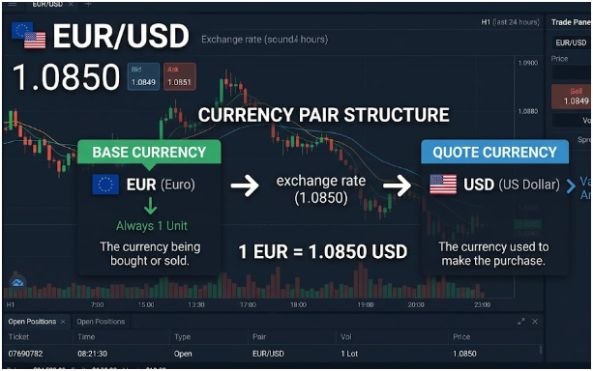
A forex quote compares two currencies. The first is the base currency. The second is the quote, or counter, currency. The rate shows how much quote currency is needed to buy one unit of the base currency.
Consider this example:
EUR/USD = 1.0850
EUR is the base currency. USD is the quote currency. One euro is therefore worth 1.0850 U.S. dollars.
I read the slash as “priced in.” EUR/USD becomes “euro priced in U.S. dollars.” That wording makes how to read a forex quote for beginners easier to remember.
A currency has no useful forex price by itself. It must be valued against another currency. This is where the internal topic why are currencies traded in pairs in forex fits naturally.
My Three-Glance Reading Method
I use the same sequence on watchlists, charts, and order tickets. It prevents me from confusing the pair’s direction with the direction of an individual currency.
Identify the Pair
Read the currency codes from left to right.
In GBP/USD, GBP is the British pound and USD is the U.S. dollar. The pound is the base currency. A rate of 1.2800 means one pound costs 1.2800 U.S. dollars.
In USD/JPY, the dollar is the base currency. A rate of 154.20 means one dollar costs 154.20 Japanese yen.
The first currency always supplies the one-unit reference. The second supplies the price.
Translate the Rate
Turn the quote into a complete sentence.
If EUR/USD rises from 1.0850 to 1.0900, one euro now buys more dollars. The euro has strengthened against the dollar.
If the pair falls to 1.0800, one euro buys fewer dollars. The euro has weakened against the dollar.
The quote shows how the relationship changed. It does not explain why the movement happened or predict the next move.
Match the Price to the Action
Trading platforms normally display two prices: a bid and an ask.
Use the bid when selling the base currency. Use the ask when buying the base currency.
This final glance turns a market quote into a price you can actually use.
How Bid, Ask, and Spread Work
Suppose your platform displays:
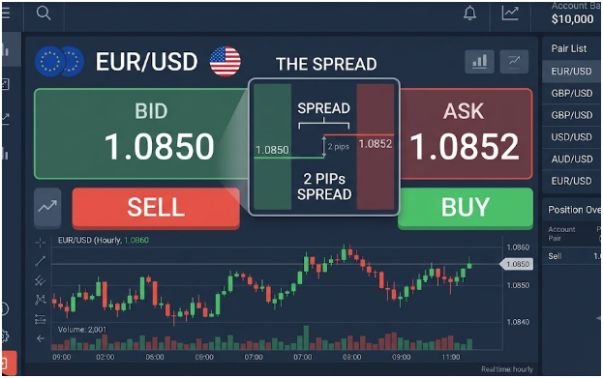
EUR/USD 1.0850 / 1.0852
The bid is 1.0850. The ask is 1.0852. U.S. retail forex requirements state that dealers should provide both the bid and offer when customers enter orders.
If I sell euros against dollars, I use the bid price. If I buy euros against dollars, I use the ask price.
The spread is calculated as follows:
1.0852 − 1.0850 = 0.0002
For EUR/USD, that difference equals two pips. The spread is a built-in transaction cost. It may not be the account’s only cost because some brokers also charge commissions or rollover fees. NFA rules separately recognize costs associated with bid-and-offer spreads.
Worked EUR/USD Example
Assume I buy EUR/USD at the 1.0852 ask price. If the market remains unchanged, I could immediately sell only at the 1.0850 bid price.
The position begins two pips below break-even.
The bid must rise from 1.0850 to 1.0852 before the position reaches its original entry level. This assumes the spread remains unchanged and no additional costs apply.
This explains why a newly opened trade may immediately display a small unrealized loss. Understanding that initial gap is part of how to read a forex quote for beginners, not an advanced trading concept.
Pips, Pipettes, and the JPY Exception
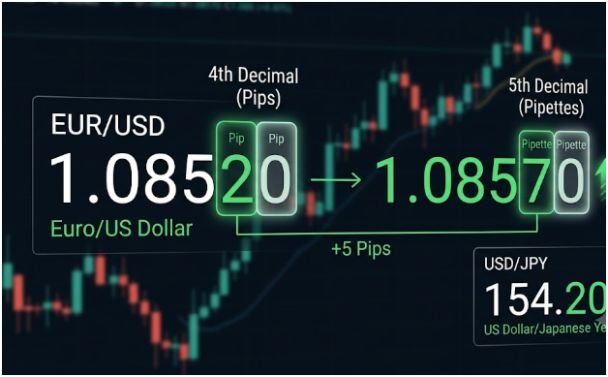
A pip measures a standard change in a forex rate. For most currency pairs, one pip appears in the fourth decimal place and equals 0.0001.
Many platforms display a fifth decimal place called a pipette. One pipette equals one-tenth of a pip.
For example:
EUR/USD moves from 1.0850 to 1.0857.
The pair has risen seven pips.
Now consider a five-decimal quote:
EUR/USD moves from 1.08527 to 1.08532.
The change is five pipettes, which equals half a pip.
The JPY Pair Exception
Japanese yen pairs use a different decimal convention.
A pip is normally the second decimal place, or 0.01. A pipette is normally the third decimal place, or 0.001.
If USD/JPY rises from 154.20 to 154.35, it has moved 15 pips.
I always identify the pair before counting decimal places. This habit prevents a beginner from making a tenfold pip-calculation error.
Reading Long and Short Trade Direction
A forex quote does not predict profit. It tells you what must happen for your trade idea to succeed.
Going long means buying the base currency and selling the quote currency. You expect the displayed exchange rate to rise.
Going short means selling the base currency and buying the quote currency. You expect the displayed rate to fall.
Buying EUR/USD expresses the view that the euro will strengthen against the dollar.
Selling EUR/USD expresses the view that the euro will weaken against the dollar.
My memory rule is simple:
Long means “pair up.”
Short means “pair down.”
This rule refers to the currency pair displayed on the platform. It does not describe either currency in isolation.
Common Beginner Mistakes
One common mistake is reversing the currencies. EUR/USD shows U.S. dollars per euro. It does not show euros per dollar.
Another mistake is using the wrong side of the quote. Buyers enter at the ask price. Sellers enter at the bid price.
Beginners may also ignore the spread. A correct directional prediction can still produce a loss when the movement is too small to cover transaction costs.
Another error involves decimals. Traders may count every final digit as a full pip, even though five-decimal quotes include pipettes. They may also apply the four-decimal rule to yen pairs.
The final mistake is treating the quote as a forecast. A quote reports the current pricing relationship. It cannot reveal where the market will move next.
These checks make how to read a forex quote for beginners practical rather than theoretical.
A U.S. Safety Check Before Trading
Retail forex may involve leverage, rapid price movements, and substantial loss risk. The Commodity Futures Trading Commission advises people to trade only markets they understand and to deal with properly registered entities. NFA rules also require risk disclosures for U.S. retail forex customers.
Before funding an account, verify the firm and its registration through NFA BASIC. Review its spreads, commissions, order-execution policy, rollover charges, and withdrawal conditions.
A demo account can help you practice reading bid and ask prices without risking real money. The CFTC also directs beginners toward simulators and free educational resources before live trading.
Practice does not remove risk, but it can prevent basic quote-reading mistakes.
Frequently Asked Questions
1. What is the easiest way to read a forex quote?
Identify the base currency, identify the quote currency, translate the rate into a sentence, and then select the bid or ask.
2. Which forex price do I use when buying?
Use the ask price when buying the base currency and the bid price when selling it.
3. How do beginners calculate a forex spread?
Subtract the bid price from the ask price and convert the difference into pips using the pair’s decimal convention.
4. Why does how to read a forex quote for beginners include pips?
Pips convert small decimal changes into a standard unit for measuring spreads and exchange-rate movements.
Read the Quote Before It Reads Your Account
I treat every forex quote as a sentence rather than a random string of numbers. The pair names the currencies, the rate explains their relationship, and the bid or ask determines the usable price.
Practice how to read a forex quote for beginners on three pairs in a demo platform. Say each quote aloud, identify the spread, and calculate a ten-pip movement.
That five-minute exercise builds more useful confidence than guessing which direction the market will take.
This article is educational and does not constitute financial or investment advice.