Forex Hacks: How to Calculate Risk to Reward Ratio Easily

Trading foreign exchange currency pairs involves navigating constant price movements across fast-moving market sessions. Learning how to calculate risk to reward ratio parameters gives you direct control over your capital before executing any order. Converting raw speculation into structured probability helps every trader preserve portfolio equity over time.
Key Takeaways
- Calculating your ratio measures trade upside potential against maximum downside exposure before entering orders.
- The formula requires dividing total profit pips by protective stop-loss pips.
- A 1:3 ratio means risking one unit of capital to earn three units in profit.
- Target ratios must align with your strategy win rate for long-term consistency.
- Automated charting tools eliminate manual calculation errors on volatile currency charts.
Understanding the Essentials of Forex Risk Management
Forex markets feature significant leverage, making structured risk controls crucial for long-term account survival. Understanding who participates in the forex market is equally important, as the actions of central banks, commercial banks, institutional investors, corporations, governments, brokers, and retail traders all influence currency prices, liquidity, and market volatility.
Recognizing the roles of these key participants helps traders better interpret market movements, anticipate potential price changes, and develop more informed trading strategies alongside effective risk management.
Why Managing Downside Matters
Preserving trading equity stands as the single most vital task for any serious currency trader. Controlling position size and downside exposure protects your available margin during natural market drawdown periods. Systematic parameters prevent a single unexpected market spike from wiping out months of hard work.
How Structure Protects Capital
Setting hard exit boundaries before opening an order removes emotional panic from real-time execution. Defining acceptable losses alongside realistic profit targets establishes clear rules for every market setup. This structural approach shields your trading capital from revenge trading and impulsive over-leveraging.
What Is the Risk-Reward Ratio Formula?
Determining trade metrics involves comparing potential losses to projected profits using standard pip values.
The Core Mathematical Equation
The basic formula for evaluating potential trade performance requires measuring distance between key price levels.
- Risk equals Entry Price minus Stop Loss Price.
- Reward equals Take Profit Price minus Entry Price.
- Ratio equals Risk divided by Reward.
For short positions, reverse the math by subtracting take profit from entry to get reward, and entry from stop loss to get risk.
Breaking Down the Math with Pips
Consider a practical EUR/USD long position where your entry price rests at 1.0850. Setting a stop loss at 1.0820 creates a risk of 30 pips, while setting a profit target at 1.0940 yields a reward of 90 pips. Dividing 30 pips of risk by 90 pips of reward produces a ratio of 1:3, meaning you risk $1 to target $3 in profit.
What Is 1:3 Risk-Reward Ratio?
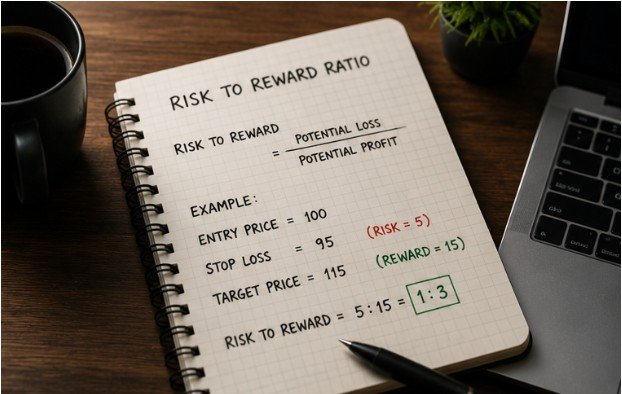
A 1:3 setup means your potential reward is three times larger than your defined downside risk.
Visualizing a 1:3 Setup
In a 1:3 trade setup, your profit target sits three times further from entry than your stop loss. Placing a 20-pip stop loss on GBP/USD requires a 60-pip take profit level. Risking $100 on this trade yields a potential return of $300, giving your portfolio substantial breathing room.
Why Traders Favor 1:3 Ratios
Currency traders lean heavily on 1:3 ratios because they lower the required win rate for long-term profitability. Operating with a 1:3 ratio allows you to lose 70% of your total trades and still keep your account net positive. Winning just three out of ten setups generates nine units of gain against seven units of loss.
Step-by-Step Guide to Calculate Risk to Reward Ratio Using Tools
Automated trading software streamlines calculation and helps visualize price distances instantly across live charts.
Step 1: Identify Key Prices
Locate your precise entry price based on your current technical strategy setup. Determine your protective stop loss near key support or resistance and set your take profit target at a logical liquidity zone.
Step 2: Measure Distance in Pips
Subtract your stop loss from entry to find total risk pips. Next, subtract entry from your take profit level to calculate total reward pips. On a stock trade example at $100 entry with a $90 stop loss and $130 target, your risk is $10 and your reward is $30.
Step 3: Apply Charting Software Tools
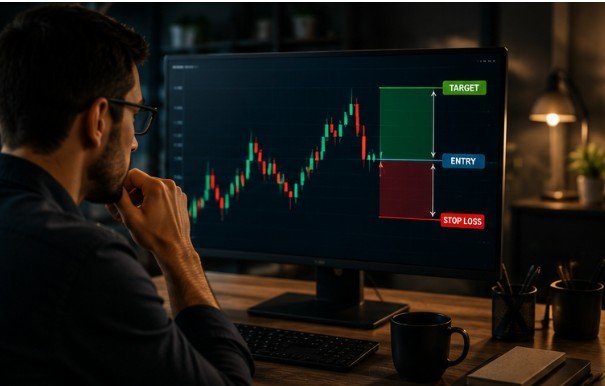
Select the built-in risk-reward tool on platforms like TradingView or MetaTrader. Drop the tool directly onto your setup candlestick to display visual color-coded risk and reward zones. The automated calculator instantly computes exact pip distances and shows your live ratio on screen.
| Trading Style | Typical Ratio | Target Win Rate | Core Objective |
| Scalping | 1:1 to 1:1.5 | 60% to 70% | Quick gains off tight spreads |
| Day Trading | 1:1.5 to 1:2 | 45% to 55% | Balanced intraday moves |
| Swing Trading | 1:2 to 1:4 | 35% to 45% | Capturing multi-day trends |
| Position Trading | 1:3 to 1:5+ | 30% to 40% | Long-term macro moves |
What Is a Good Risk-to-Reward Ratio?
Optimal target ratios vary based on your personal execution style and underlying strategy metrics.

Matching Style with Ratio Benchmarks
Scalpers often work with tighter 1:1 ratios because high execution speed requires quick profit taking. Swing traders typically seek 1:2 or 1:4 ratios to capture broader multi-day price swings. Selecting the right benchmark ensures your target expectations fit market conditions.
Balancing Win Rate with Return Ratios
A high 1:4 ratio setup fails if your entry system only wins 15% of the time. Conversely, a modest 1:1 ratio succeeds consistently when paired with a reliable 65% strategy win rate. Aligning your return ratio with account win rates creates positive statistical expectancy over time.
Execution Realities: Planned vs Realized R:R
Theoretical trade models often shift once live orders fill across active broker feeds.
Managing Slippage and Spreads
Broker spreads instantly affect your true fill price, altering planned entry calculations. Fast market conditions during major news events cause slippage that widens stop loss distances unexpected. Accounting for average spreads ensures market friction does not destroy your trading edge.
Adjusting for Partials and Trailing Stops
Taking partial profits at early chart targets reduces overall account risk but lowers your final realized ratio. Trailing a stop loss locks in profit while shifting the total payout ratio on remaining position lots. Logging realized execution numbers in your journal tracks true dollar performance accurately.
Frequently Asked Questions
1. What is the simplest way to explain how to calculate risk to reward ratio?
To calculate the ratio, identify your entry, stop-loss, and take-profit prices. Subtract stop-loss from entry to find risk, subtract entry from take-profit to find reward, and divide risk by reward. A 20-pip risk with a 60-pip target yields a 1:3 ratio.
2. Can a 1:1 risk-to-reward ratio remain profitable over time?
Yes, a 1:1 ratio generates profits provided your strategy maintains a win rate above 55%. High win-rate scalpers routinely use 1:1 ratios effectively.
3. How does stop loss placement change my overall trade ratio?
Placing a tighter stop loss increases your ratio but raises the likelihood of market noise triggering an early exit. Always position stops behind key technical structure.
4. Should I skip forex setups with low return ratios?
Skipping setups below your system baseline protects capital and enforces trading discipline. Filtering out low-reward setups keeps your focus on high-probability opportunities.
Level Up Your Forex Game
Mastering how to calculate risk to reward ratio elevates your trading from casual guessing into a structured, professional business. Combining disciplined pip math with proper position sizing protects account equity across changing market environments. Focus on executing high-expectancy setups, track realized trade performance continuously, and let mathematical probabilities drive your long-term forex success.