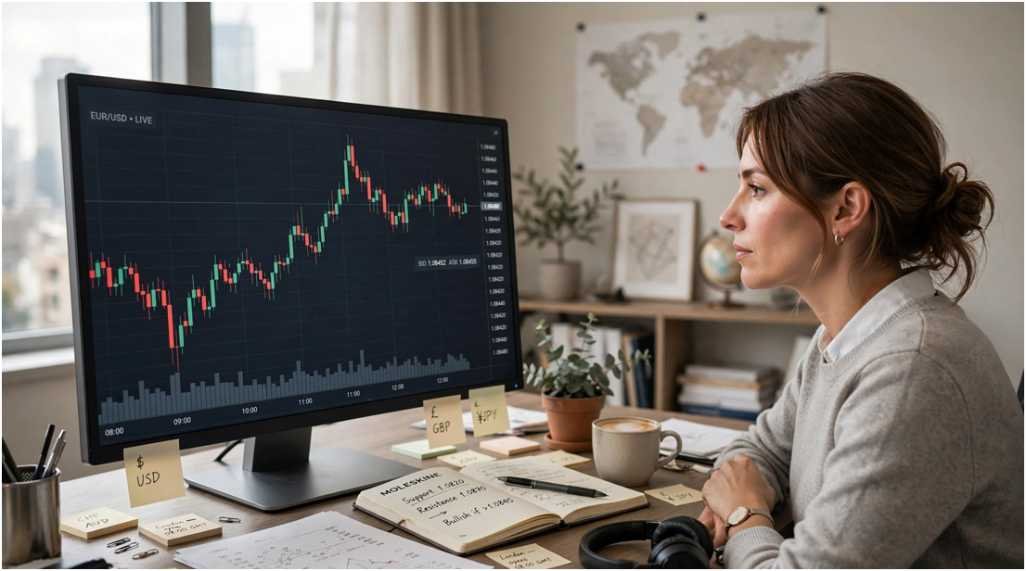
A spot forex quote can rise while a new long trade still shows a loss. That happens because traders buy at the ask, sell at the bid, and absorb the spread between them. Understanding what is spot forex trading and how does it work requires more than predicting which currency will strengthen.
I treat spot forex as an execution problem first and a market forecast second. That approach keeps spreads, leverage, financing costs, and risk visible before I place a trade.
What Spot Forex Trading Actually Means

Spot forex trading involves buying one currency while simultaneously selling another at an exchange rate agreed today. Most institutional spot transactions settle within two business days. USD/CAD transactions commonly settle within one business day.
Forex operates over the counter rather than through one centralized exchange. Banks, dealers, investment funds, businesses, governments, and retail traders connect through electronic networks and bilateral relationships.
The Bank for International Settlements reported average OTC foreign-exchange turnover of $9.6 trillion per day in April 2025. Spot trades represented 31% of that total, implying roughly $3 trillion in daily spot turnover.
Currency Pairs, Base Currency, and Quote Currency
Currencies trade in pairs because every transaction exchanges one currency for another.
In EUR/USD, EUR is the base currency and USD is the quote currency. A rate of 1.1000 means one euro costs 1.10 US dollars.
Buying EUR/USD means expecting the euro to strengthen against the dollar. Selling the pair means expecting the euro to weaken. A trader’s result depends on how the exchange rate changes after entry.
Spot Settlement Versus Retail Rollover
Institutional spot trades may result in actual currency delivery. Most retail traders instead use leveraged OTC accounts and close their positions before settlement.
When a position remains open, the broker generally rolls it to a later value date. That rollover may create an overnight financing charge or credit. The amount depends on the currency pair, trade direction, broker pricing, and rollover policy.
“Spot” therefore does not mean physical currency arrives the moment I click the buy button. It refers to the market’s standard near-term settlement convention.
To understand where dealer liquidity and currency pricing begin, read what is the interbank forex market and how does it work.
How Does a Spot Forex Trade Work?
Every spot trade has three stages: entry, holding, and exit. Each stage can affect the final profit or loss.
Bid, Ask, Spread, and Pips
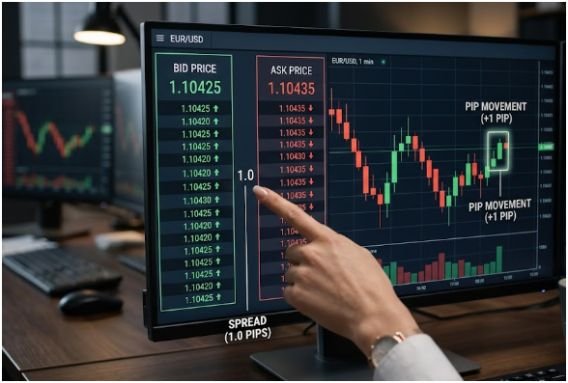
The bid is the price at which I can sell the base currency. The ask is the price at which I can buy it. The difference between those prices is the spread.
Suppose EUR/USD displays the following quote:
1.1000/1.1002
I can sell euros at 1.1000 or buy them at 1.1002. A new long position begins two pips behind because it enters at the higher ask price.
For most currency pairs, one pip equals 0.0001. Yen pairs usually use 0.01 as one pip. Some trading platforms also display fractional pips, sometimes called pipettes.
The spread is a real trading cost. The market must move far enough to cover it before the position reaches break-even.
Long and Short Positions
A long position buys the base currency and sells the quote currency. A short position does the reverse.
I do not need to own euros before selling EUR/USD. The broker structures the position as a paired currency transaction.
Closing the position reverses the opening order. A long position closes by selling at the bid. A short position closes by buying at the ask.
The final result reflects:
- The exchange-rate movement
- The position size
- The spread
- Commissions
- Overnight financing
- Execution slippage
This complete calculation provides the practical answer to what is spot forex trading and how does it work. Correctly predicting direction does not guarantee a profitable trade.
A Worked Spot Forex Example
Assume EUR/USD is quoted at 1.1000/1.1002. I expect the euro to strengthen, so I buy 10,000 euros at the ask price of 1.1002.
The position has a notional value of approximately $11,002.
Later, EUR/USD rises to 1.1052/1.1054. I close the long position by selling at the available bid price of 1.1052.
My executable price movement is:
1.1052 − 1.1002 = 0.0050, or 50 pips
With a 10,000-euro position and USD as the quote currency, each pip is worth approximately $1. The gross gain is therefore about $50 before commissions and overnight financing.
My Two-Price Test
I calculate each trade using the actual entry and exit sides of the quote rather than a chart’s midpoint.
A chart might appear to show a 52-pip rise from 1.1000 to 1.1052. However, the trade captured only 50 pips because I entered at the ask price of 1.1002.
This two-price test explains why a trader can predict the direction correctly but still lose money. Price must first cover the spread before creating a net gain.
The test becomes especially valuable around economic announcements. Spreads may widen sharply when liquidity falls or prices move quickly.
Leverage, Margin, and Overnight Costs
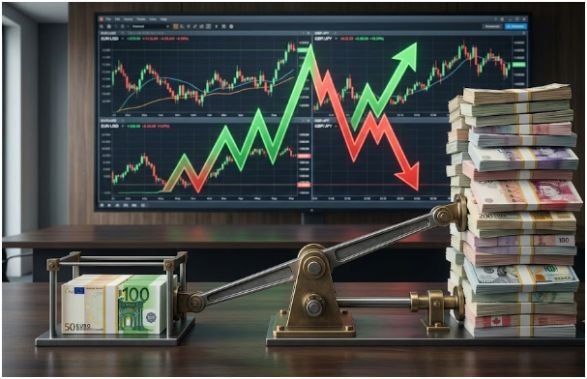
Leverage allows a relatively small deposit to control a larger currency position. Margin is the amount a broker requires to maintain that exposure. It is not the most a trader can lose.
US retail forex rules generally require a 2% security deposit for major currency pairs and 5% for other pairs. These requirements correspond to maximum leverage of 50:1 and 20:1.
The Commodity Futures Trading Commission warns that leverage magnifies both gains and losses. Traders may lose their deposited margin and, in some circumstances, more than the original deposit.
Consider an account using $1,000 to control a $50,000 position. A 1% adverse market move equals approximately $500 before trading costs. Half the deposit can disappear after a move that looks small on a price chart.
Overnight financing adds another cost. Even when a currency has a higher interest rate, a positive rollover credit is not guaranteed. Brokers may use different calculations and add financing markups.
Spot Forex Versus Forex Futures
Spot forex uses OTC pricing, flexible position sizes, and positions that can roll from one trading day to the next.
Forex futures use standardized contracts traded on regulated exchanges. They have defined contract sizes, expiration months, and centralized clearing.
Exchange trading provides greater displayed-price transparency. CME Group notes that participants can view the same exchange prices, quotes, and completed trades.
Neither product is automatically better.
Spot traders must evaluate dealer pricing, spreads, rollover policies, and counterparty exposure. Futures traders must manage standardized contract sizes, expiration dates, basis risk, and exchange margin requirements.
Major Risks for US Retail Traders
Leverage receives the most attention, but execution risk can be just as damaging.
Spreads may widen during major news releases. Stop orders may experience slippage. Weekend gaps can also cause a position to close beyond its intended stop price.
OTC trading introduces counterparty risk because the retail dealer may act as the other side of the transaction. US regulations permit only certain regulated entities to serve as counterparties for retail off-exchange forex trades.
Fraud presents another serious danger. The CFTC identifies several warning signs, including guaranteed returns, pressure to continue conversations through private messaging apps, cryptocurrency-only deposits, unregistered dealers, and leverage exceeding US limits.
Checks I Would Make Before Trading
I would begin by checking the broker through NFA BASIC. This free database provides registration, membership, and disciplinary information about derivatives firms and industry professionals.
Next, I would read the customer agreement and identify every possible charge. That includes spreads, commissions, rollover costs, withdrawal fees, and inactivity fees.
I would then define the maximum dollar loss before selecting a position size. Choosing the maximum available leverage first and deciding risk afterward works backward.
The stop distance should reflect the trade idea. The position size should make that stop affordable.
Finally, I would practice the full process through a demo account. I would test entries, stop orders, profit targets, rollover cutoffs, and manual exits. Demo trading cannot reproduce every live condition, but it can reveal expensive order-entry mistakes without risking cash.
Frequently Asked Questions
1. Is spot forex the same as exchanging money for travel?
No. Travel exchange normally involves physical currency, while retail spot trading often uses leveraged OTC positions without personal delivery.
2. How long can a spot forex position remain open?
It can usually remain open while sufficient margin is available, although daily financing charges or credits may apply.
3. Does spot forex settle immediately?
No. Most institutional spot transactions settle within two business days, while retail positions are commonly closed or rolled first.
4. What is spot forex trading and how does it work for beginners?
It involves buying one currency and selling another, then gaining or losing from the rate movement after spreads, fees, financing, and leverage.
Final Take: The Market Is Fast, but You Should Not Be
The practical answer to what is spot forex trading and how does it work is straightforward: it is a two-sided currency transaction whose outcome depends on execution, size, costs, and risk—not only a correct prediction.
My next step would not be increasing leverage. I would choose one major pair, record both sides of every quote, and calculate the true break-even price before entering.
The market can move within milliseconds. Your risk decision deserves more time.