What Is The Interbank Forex Market And How Does It Work
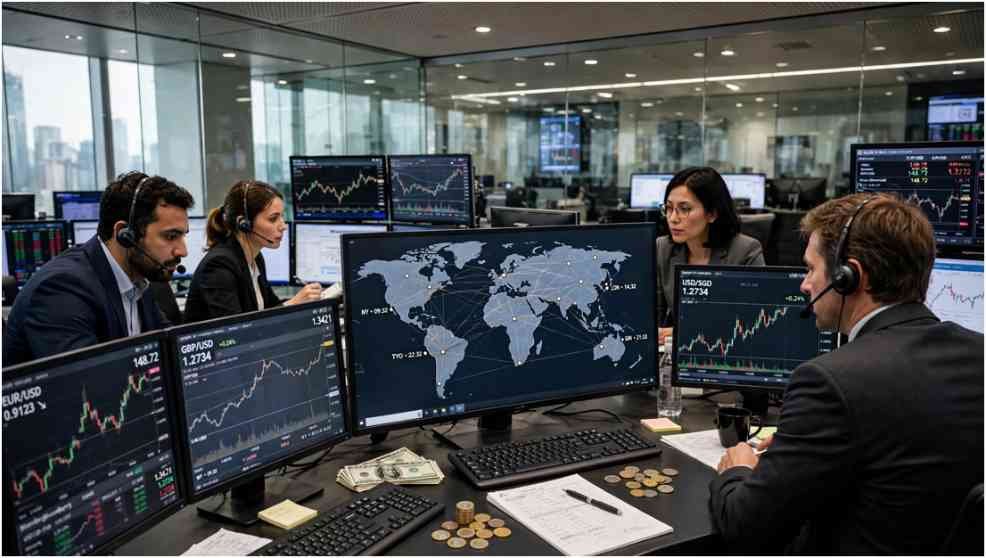
When I examine a forex quote, I start behind the broker screen. The price usually begins in a wholesale network where major institutions exchange currencies and manage risk. Understanding what is the interbank forex market and how does it work explains why rates move, why spreads differ, and why retail traders rarely receive bank-level pricing.
What Is the Interbank Forex Market?
The interbank forex market is the wholesale layer of foreign exchange. Large banks and qualified institutions trade currencies for clients, hedging, liquidity management, and proprietary activity.
It has no single trading floor or central exchange. Deals occur over the counter through electronic venues, direct bank connections, and voice channels. The Federal Reserve Bank of New York describes foreign exchange as a global, decentralized market spread across many separate trading venues.
The scale is enormous. The Bank for International Settlements reported average over-the-counter forex turnover of $9.6 trillion per day in April 2025. Interdealer transactions represented $4.4 trillion, or 46% of total turnover.
These figures cover the broader institutional forex market, including spot transactions, swaps, forwards, options, and other currency instruments. The interbank segment is the part where reporting dealers trade with one another.
Who Trades in the Wholesale Currency Market?

Dealer Banks
Large commercial and investment banks sit at the center of the network. They quote bid and ask prices, execute customer orders, maintain currency inventories, and trade with other dealers.
A bank often acts as principal. This means it takes the other side of a transaction rather than merely introducing a buyer to a seller. The bank may hold that position, offset it internally, or hedge it elsewhere.
Central Banks and Large Institutions
Central banks may trade currencies to manage reserves or conduct policy-directed intervention. In the United States, the New York Fed can execute foreign exchange transactions when directed by the Federal Open Market Committee or the U.S. Treasury.
Asset managers, hedge funds, multinational companies, pension funds, and smaller banks usually access wholesale liquidity through dealer banks or institutional platforms. They may trade to adjust portfolios, pay international expenses, speculate on exchange-rate movements, or hedge foreign-currency exposure.
Brokers and Retail Traders
Retail traders sit outside the core interbank tier. Their brokers may receive prices from banks, non-bank liquidity providers, aggregators, or internal dealing systems.
The broker then converts those inputs into the executable quote shown on its platform. That quote may contain a spread markup, commission, or both.
How Does Interbank Forex Trading Work?

Banks Stream Bid and Ask Prices
An interbank currency quote contains a bid and an ask. The bid is where the dealer buys the base currency. The ask is where it sells. The difference between those prices is the bid-ask spread.
There is no universal interbank quote that every institution must accept. Pricing changes with available liquidity, transaction size, market volatility, counterparty credit, and the dealer’s existing inventory.
Major currency pairs often carry tighter spreads because more institutions compete to trade them. Less-liquid or restricted currencies may have wider prices and fewer available counterparties.
Credit Controls Market Access
Institutional access depends on more than account size. Banks establish bilateral credit limits before they trade with each other.
A platform may display an attractive price, but a participant can execute only when it has sufficient credit with the institution offering that price. The best visible quote is therefore not always the best executable quote.
Prime brokerage can give approved institutions access to more counterparties. However, the prime broker assumes counterparty exposure and imposes limits, collateral requirements, and risk controls.
This credit-based structure is one reason ordinary traders cannot connect directly to the wholesale market.
Institutions Use Electronic and Direct Trading
Banks trade through central limit order books, request-for-quote systems, streaming-price platforms, direct dealing systems, and voice brokers.
CME Group describes EBS Market as a professional central limit order book for instruments including spot forex and non-deliverable forwards. LSEG operates institutional services such as Matching, FXall, and Advanced Dealing.
These systems automate much of the trading process. However, large, complex, or less-liquid transactions may still be negotiated directly between institutions.
Dealers Internalize or Hedge Orders
A bank does not automatically send every customer order into the interdealer market.
Suppose one customer buys euros while another customer sells a similar amount. The bank may offset those orders inside its own trading book. This process is known as internalization.
It is a crucial feature that many basic explanations overlook. BIS research based on the 2025 market survey found that dealers matched more than 80% of customer transactions within their own internal liquidity pools.
The bank generally needs an external hedge only when customer orders leave it with an unwanted net currency position. This helps reduce market impact, transaction costs, and unnecessary trading.
Worked Example: Following a EUR/USD Trade
Assume a U.S. company must buy €5 million to pay a European supplier. Its bank quotes EUR/USD at 1.08498/1.08500.
The company buys euros at the ask price of 1.08500. It therefore pays:
€5,000,000 × 1.08500 = $5,425,000
Before completing the transaction, the bank checks the company’s available credit and confirms the trade.
Suppose another customer is selling €5 million. The bank may offset the two orders internally. If no matching customer order exists, the bank can hedge some or all of its euro exposure with another dealer or through an electronic venue.
Now compare an illustrative retail quote of 1.08490/1.08510. The retail spread is two pips, while the institutional example has a spread of 0.2 pip.
The wider retail spread may compensate for smaller transaction sizes, brokerage services, market risk, technology, and operational costs. These figures demonstrate the pricing mechanism and are not live market quotes.
Both Currency Legs Must Settle
Every forex trade contains two payment obligations. One party delivers one currency while the other delivers the second currency.
The main danger is that one participant sends its payment but fails to receive the currency it purchased. Time-zone differences between national payment systems can increase this exposure.
Payment-versus-payment settlement reduces the risk by making each currency transfer conditional on the other. CLS states that its settlement process synchronizes the two currency legs so one payment does not settle without the corresponding payment.
How Interbank Prices Reach Retail Traders
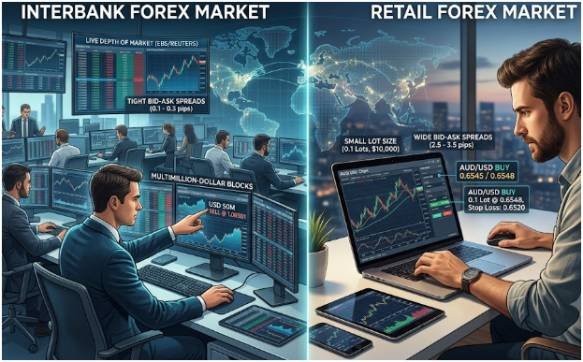
Wholesale transactions shape the rates shown by brokers, banks, payment companies, and financial websites. However, retail pricing is not a direct copy of one interbank quote.
A broker may combine feeds from several liquidity providers. It can then add a markup, charge a separate commission, or internalize customer orders.
Spreads may widen during thin liquidity, major economic announcements, unexpected political events, or rapid price movements. The result is a two-tier structure: an inner wholesale market with credit-dependent institutional pricing and an outer retail market designed for smaller accounts.
Trading sessions also affect liquidity and execution costs. For a session-by-session explanation, read what time does the forex market open and close.
Interbank Forex Versus Retail Forex
The interbank market primarily serves institutions trading large amounts through approved credit relationships. Retail forex serves individuals placing smaller orders through regulated brokers.
Wholesale participants often receive tighter, institution-specific prices. Retail clients receive broker-created quotes based on upstream liquidity, account type, order size, and the broker’s execution model.
Interbank transactions can involve millions of currency units, while retail platforms offer micro, mini, and standard lots. Retail accessibility is far greater, but traders pay for that access through spreads, commissions, financing charges, or other account costs.
The wholesale market is also not simply “self-regulated.” National laws and financial regulations still apply.
The FX Global Code adds voluntary principles covering conduct, execution, information sharing, governance, risk management, and settlement. The Code supplements applicable regulation rather than replacing it.
What Risks Matter Most?
Counterparty credit risk arises when a trading partner may fail to complete its obligation. Banks control it through credit limits, legal agreements, collateral arrangements, and continuous exposure monitoring.
Settlement risk appears when one currency is delivered before the other. Payment-versus-payment systems help reduce this principal risk.
Liquidity risk increases when dealers reduce available quotes, widen spreads, or withdraw credit during market stress. A failure at a major institution can also affect pricing and execution elsewhere because dealers are connected through trading, settlement, and funding relationships.
Operational risk remains significant. Incorrect settlement instructions, unreliable data, failed interfaces, or communication errors can create losses even when the original market decision was correct.
No Trading Floor, No Mystery
Once I trace a quote from customer demand through bank inventory, hedging, and settlement, the system becomes much clearer. The answer to what is the interbank forex market and how does it work is not simply that banks trade currencies privately. It is a structured wholesale network built on pricing, credit, risk transfer, and payment infrastructure.
My practical tip is to treat a retail quote as the final product of several upstream decisions. Before judging a spread, check the currency pair, trading session, volatility, broker model, and order size.
Frequently Asked Questions
1. Is the interbank forex market open to retail traders?
No. Retail traders usually access currency markets through brokers that source, aggregate, or create prices from institutional liquidity.
2. How do banks profit from interbank forex?
Banks may earn from bid-ask spreads, customer markups, commissions, market-making activity, hedging services, and proprietary positions.
3. Does the interbank market set exchange rates?
It strongly influences spot exchange rates through institutional order flow, although no single bank sets one universal forex price.
4. What is the interbank forex market and how does it work for brokers?
Brokers receive or aggregate wholesale prices, apply their costs and execution rules, and then offer tradable quotes to retail customers.