
A currency price never moves because of one trader alone. When I study who are the main participants in the forex market, I focus on who supplies liquidity, who transfers risk, and who can influence prices.
The main groups are central banks, commercial and investment banks, institutional investors, hedge funds, multinational corporations, brokers, and retail traders. They use the same global market, but their motives and resources differ significantly.
Why the Forex Market Has a Hierarchy
Forex does not operate through one central exchange. Most spot and derivative transactions occur over the counter. Dealers connect buyers and sellers through direct relationships, electronic venues, and voice trading.
The Bank for International Settlements describes the market as decentralized and fragmented. Large dealer banks sit near the top because they quote wholesale prices and process major order flows. Funds and corporations generally obtain liquidity through those institutions. Retail traders usually access prices through brokers or dealers.
The scale explains why this hierarchy matters. Average daily over-the-counter forex turnover reached $9.6 trillion in April 2025. Inter-dealer activity represented 46% of turnover. Trades with other financial institutions represented 50%, while non-financial customers accounted for only 5%.
Those figures provide a data-based answer to who are the main participants in the forex market. Banks and other financial institutions dominate measurable global activity.
Central Banks and Government Authorities

Central banks participate to pursue monetary and exchange-rate objectives rather than ordinary trading profits. They manage national currency reserves, provide foreign-currency liquidity, and may buy or sell currencies during disorderly market conditions.
Their interest-rate decisions can also influence exchange rates without direct intervention. Higher rates may increase demand for a currency. An unexpected rate cut may reduce that demand.
This policy role belongs in every explanation of who are the main participants in the forex market. I view central banks as market architects because their decisions can reset expectations across every participant tier.
The International Monetary Fund explains that intervention changes the available supply of domestic and foreign currencies. However, its effectiveness depends on reserves, banking liquidity, economic fundamentals, and market confidence.
Commercial and Investment Banks

Commercial and investment banks form the operational core of forex. They are essential to who are the main participants in the forex market because they connect wholesale institutions with customer order flow.
Banks execute transactions for corporations, investment funds, governments, and other banks. They also quote bid-and-ask prices, hedge their exposure, and trade using their own capital within strict risk limits.
Dealer Banks as Liquidity Providers
A dealer bank may quote euros to a corporation, dollars to a pension fund, or yen to another bank. It can match opposing customer orders internally or transfer the remaining exposure into the wider market.
For example, one customer may need to buy euros while another needs to sell them. The bank can match those transactions without sending both orders elsewhere.
This process creates liquidity and reduces unnecessary market impact. It also explains why large banks can influence short-term pricing during volatile periods.
The Interbank Market
The interbank market is the upper tier where major banks and institutional dealers trade with one another. It allows them to redistribute currency exposure and establish wholesale prices.
The BIS recorded approximately $4.4 trillion in average daily inter-dealer turnover during April 2025. It also found that dealers match more than 80% of customer transactions inside their own liquidity pools. Much of the market therefore operates away from a visible public exchange screen.
Institutional Investors and Hedge Funds
Institutional investors include pension funds, mutual funds, insurance companies, sovereign wealth funds, and professional asset managers. They exchange currencies when purchasing foreign assets, repatriating returns, or hedging international portfolios.
Consider a U.S. pension fund buying European government bonds. The fund may need euros to complete the purchase. It may later sell euros through a forward contract to protect its dollar-based returns.
Hedge funds and proprietary trading firms often pursue different objectives. They may trade macroeconomic themes, momentum, relative value, arbitrage, or short-term pricing differences.
This group matters when examining who are the main participants in the forex market because institutional portfolios can move large amounts of capital quickly.
In the 2025 BIS survey, institutional investors represented 13% of global turnover. Hedge funds and proprietary trading firms represented another 8%.
Multinational Corporations
Multinational corporations are a necessary part of who are the main participants in the forex market. They use currency transactions to conduct business and control financial risk.
Companies convert foreign revenue, pay overseas suppliers, fund international subsidiaries, and protect future cash flows. Their currency needs often come from real commercial obligations rather than market speculation.
Imagine that a U.S. importer must pay €5 million for equipment in 90 days. A stronger euro would increase the invoice’s dollar cost. The company could use a forward contract to lock its exchange rate today.
The business is seeking cost certainty, not necessarily a trading profit. This difference matters because many large currency transactions begin with payroll, trade, investment, or supply-chain requirements.
Brokers, Dealers, and Retail Traders
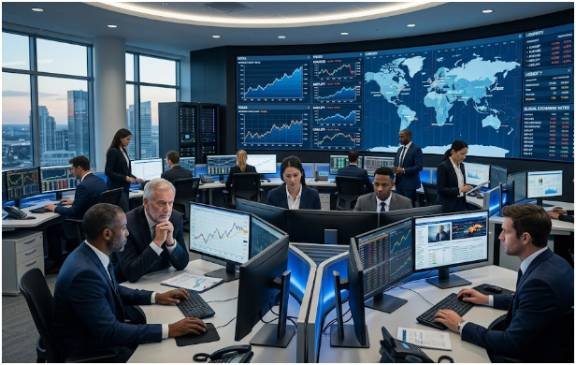
Retail brokers and forex dealers provide trading platforms, account access, pricing, margin, and leverage. They allow individuals to participate without establishing direct relationships with major institutional banks.
The legal and operational structure matters. In U.S. retail over-the-counter forex, a customer generally trades against a dealer rather than through an open exchange.
The Commodity Futures Trading Commission advises traders to verify a dealer’s registration and disciplinary history. It also warns that the dealer controls the platform, displayed prices, trading conditions, and available exit prices.
Retail traders complete the practical answer to who are the main participants in the forex market. They speculate using economic announcements, technical analysis, sentiment, or systematic trading rules.
Their individual orders are small compared with bank or fund transactions. Collectively, however, they create a significant customer market for retail dealers.
Before choosing instruments, traders should understand what are major minor and exotic currency pairs because liquidity, spreads, price stability, and execution conditions differ across pair categories.
How One Forex Order Moves Through the Market
A worked order-flow example makes who are the main participants in the forex market easier to understand.
Suppose a U.S. manufacturer must purchase Japanese machinery priced in yen. The company requests a USD/JPY quote from its commercial bank. The bank sells yen to the company and accepts the opposite currency exposure.
The bank may offset that position against another customer order. If no suitable order exists, it can hedge with another dealer or use an electronic trading venue.
A pension fund, hedge fund, asset manager, or non-bank liquidity provider may eventually accept the opposite exposure through another institution.
One commercial payment can therefore involve:
Corporation → Dealer bank → Electronic venue → Second bank → Institutional investor
The corporation receives the currency it needs. The dealer earns a spread and manages the resulting exposure. Other institutions provide the liquidity required to transfer that risk.
This chain is the article’s key original insight: forex participants should not be viewed as isolated groups. They form a connected risk-transfer network.
Why Market Participants Matter to Traders
Knowing who are the main participants in the forex market helps me interpret price movement more accurately.
A central-bank announcement can reset interest-rate expectations. Portfolio rebalancing may create institutional buying or selling. Corporate hedging can generate steady demand near certain price levels. Dealer risk limits may reduce liquidity during sharp market moves.
This knowledge prevents a common mistake: assuming every movement comes from a technical chart pattern. A chart displays the result of transactions, but it does not reveal each participant’s motive.
Before considering a trade, I ask three questions:
Who may be active? Why do they need the currency? How long could their order flow continue?
These questions cannot guarantee a correct forecast. They can, however, give price movement a stronger economic context.
Frequently Asked Questions
1. Who are the main participants in the forex market?
The main participants are central banks, commercial banks, investment banks, funds, corporations, brokers, dealers, and retail traders.
2. Who are the biggest forex market participants?
Major dealer banks and financial institutions dominate turnover through interbank and institutional transactions.
3. Why do multinational companies use forex?
They convert international cash flows and hedge future currency expenses, revenue, debt, and supplier payments.
4. Are retail traders major forex participants?
Retail traders are highly visible, but they operate on a much smaller tier than banks, funds, and multinational corporations.
The Market Is Bigger Than Your Trading Screen
Understanding who are the main participants in the forex market turns a basic list into a working market map. Banks provide liquidity, central banks shape policy, funds move investment capital, corporations hedge business exposure, and retail traders access prices through dealers.
My next step is simple: before analyzing a currency pair, I identify which participant has the strongest reason to buy or sell it.
Price shows what happened. Market structure helps explain why.