Learn Forex 1 Percent Rule Risk Management Hacks to Win

Standing in front of live charts after a three-trade losing streak once felt like facing a violent storm without an umbrella. Every price movement seemed threatening, and the temptation to recover losses quickly often clouded my judgment.
Applying the forex 1 percent rule risk management model changed that experience completely. By limiting the amount at risk on each trade, I replaced fear and impulsive decisions with clear boundaries, consistent position sizing, and a repeatable business process built for long-term survival.
Key Takeaways
- Capping risk at 1% of equity per trade protects your account against catastrophic drawdowns.
- Position sizing depends directly on your technical stop-loss distance and specific pair pip value.
- Watching currency correlation prevents hidden over-exposure across multiple open trades.
- Dynamic risk scaling keeps recovery math manageable during temporary losing streaks.
- Automated position calculators eliminate fast market errors and keep trading discipline sharp.
How the 1% Rule Protects You
Think of forex 1 percent rule risk management as a bulletproof vest for your trading account. Market movements can get wildly unpredictable, but capping your potential loss at one percent keeps you in the game indefinitely. It turns terrifying drawdowns into minor bumps in the road.
This simple rule acts as a safety barrier that stops emotional mistakes like revenge trading from destroying your capital. When individual losses stay small, you stay cool, analytical, and ready for the next setup.
Understanding what is leverage in forex trading is also essential because leverage determines how much market exposure you control relative to your available account equity. The 1% rule prevents that purchasing power from turning into excessive risk by limiting the actual dollar amount you can lose, regardless of the maximum leverage offered by your broker.
The Rule Works for Long Term Survival
Account Scaling Dynamics
The dollar amount you risk automatically adjusts as your portfolio balance changes over time. When your account balance grows from wins, your 1% dollar risk grows accordingly, accelerating your overall profit compounding.
Conversely, when your account experiences a temporary dip, your 1% dollar risk drops, naturally shrinking your position sizes and protecting remaining equity.
Ultimate Survival Protection
Math proves why professional traders respect this rule above almost all other strategy elements. It takes 100 consecutive losing trades in a row to completely wipe out an account using this strategy.
Because a 10% drawdown requires an 11.1% gain to break even while a 50% loss demands a 100% gain, keeping losses tiny keeps recovery fast.
Stress Reduction and Psychological Clarity
Trading with small, controlled risk keeps your personal emotions low so fear rarely influences decisions. You can execute trade entries without hesitation because knowing your worst-case outcome is capped at a tiny fraction of your account gives you complete mental freedom.
How to Calculate Position Size with 1 Percent Rule
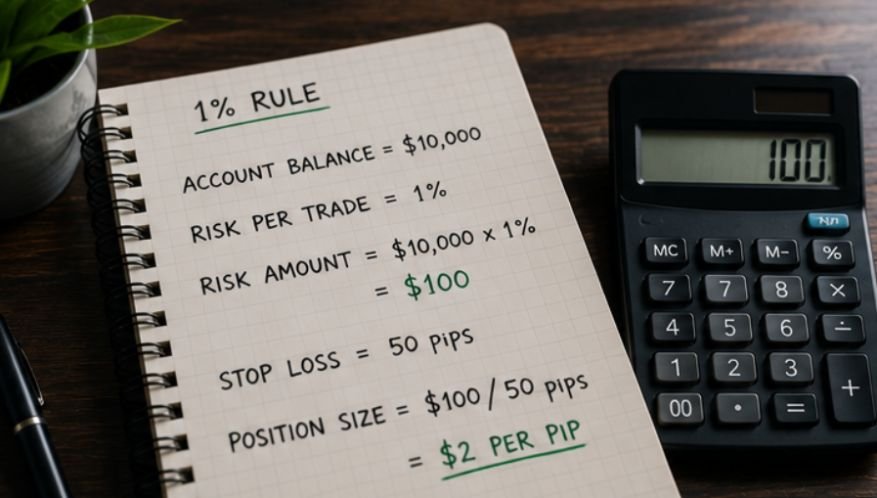
Finding Maximum Dollar Risk
Start your position sizing calculation by taking your current account balance and multiplying it by 0.01. On a standard $10,000 trading account, your maximum allowable loss on any single trade is capped at exactly $100.
Determining Stop Loss in Pips
Analyze your price charts to identify a logical technical invalidation level for your trade setup. Measure the distance in pips between your entry price and your proposed stop-loss line, such as a 50-pip stop.
Calculating Pip Value and Setting Lot Size
Divide your maximum dollar risk by your stop-loss pip distance to determine your exact limit per pip. In this example, dividing $100 by 50 pips yields a maximum allowance of $2 per pip. Adjust your micro, mini, or standard lots so hitting your stop loss results in that exact dollar limit, which means trading two mini lots.
Hidden Correlation Risks Most Traders Ignore
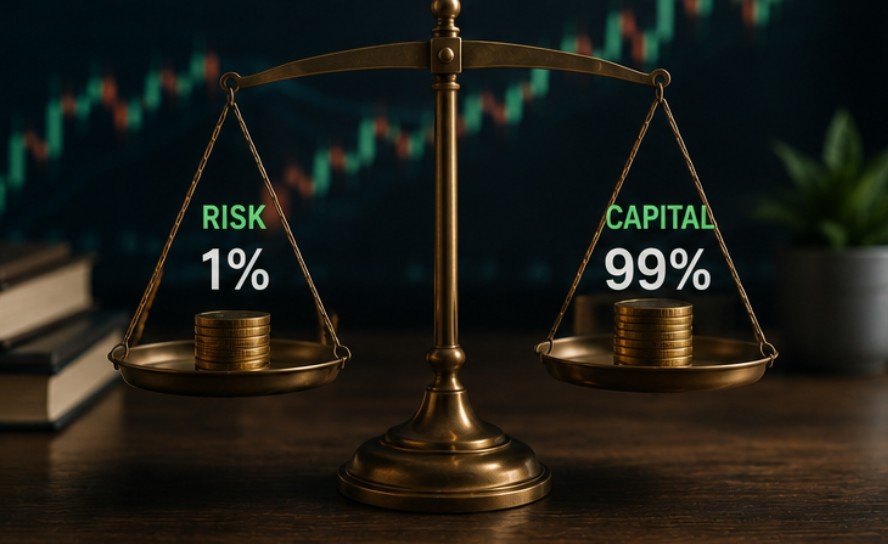
Positively Correlated Currency Pairs
Opening simultaneous trades on EUR/USD and GBP/USD might feel like diversifying your market exposure. However, because these European pairs share a strong positive correlation, dollar movements usually push both in the same direction.
Stopped out on both setups simultaneously effectively doubles your portfolio risk to 2% on what was essentially a single market direction idea.
Managing Total Portfolio Exposure
Setting a total active portfolio risk cap keeps your overall account safe from unexpected news shocks. Establishing a firm rule where combined open trades never exceed 2% to 3% total risk keeps individual trade clusters from causing severe equity drawdowns.
Dynamic Risk Scaling and Winning Execution
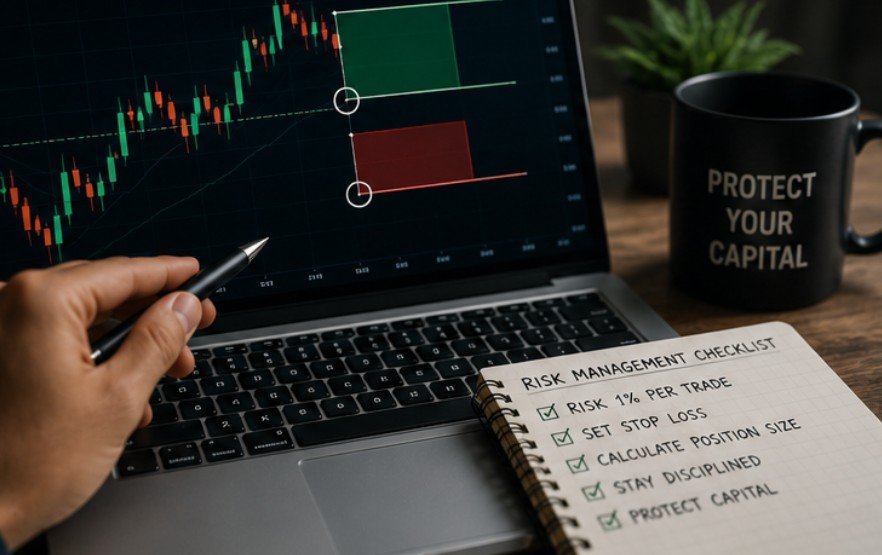
Lowering Risk During Drawdowns
When hit with three or four consecutive losses, temporarily lower your position size from 1% down to 0.5%. Cutting trade sizing in half during cold streaks protects core capital while lowering mental stress until your edge aligns with market conditions again.
Pairing Small Risk with Favorable Ratios
Combining a 1% risk rule with a minimum 1:2 risk-to-reward ratio completely shifts your statistical expectations. Winning just 40% of your trades with disciplined 1:2 reward targets pushes your equity curve steadily upward over a large sample of setups.
Understanding how to calculate risk to reward ratio allows you to compare the distance between your entry and stop-loss with the distance to your profit target. For example, risking $100 to pursue a potential $200 return creates a 1:2 ratio, while targeting $300 for the same risk creates a 1:3 ratio.
Leveraging Automation Tools
Modern broker terminals and web calculators help remove manual calculation mistakes during fast news events. Utilizing position sizing tools ensures your lot size, pip values, and stops match your risk guidelines perfectly before you click submit.
Frequently Asked Questions
1. What is the 1% rule in risk management?
The 1% rule is a foundational capital preservation strategy where a trader never risks losing more than 1% of their total trading account balance on any single market position.
2. How to risk 1 percent per trade forex?
You risk 1 percent per trade in forex by calculating your maximum dollar loss, measuring your technical stop-loss distance in pips, and choosing a lot size that matches that exact dollar limit.
3. What is the 1% rule in forex?
The 1% rule in forex caps your maximum potential loss at 1% of account equity per trade, ensuring you can survive long losing streaks without ruining your trading account.
4. Is risking 2% per trade too much?
Risking 2% per trade is acceptable for experienced traders, but it doubles your drawdown rate during bad streaks, making 1% a much safer long-term standard for capital preservation.
Level Up Your Trading Game with Forex 1 Percent Rule Risk Management
Mastering forex 1 percent rule risk management turns unpredictable price movements into a structured financial business. Calculating exact lot sizes based on stop-loss pips, avoiding correlated pair traps, and shrinking risk during drawdowns keeps your portfolio safe. Focus on protecting your capital first, stick to your sizing plan every single session, and let your edge compound your long-term profits.