99% Fail This But Not You! How To Size Forex Trades Properly
Staring at a blown account balance after a sudden market spike is a painful rite of passage. Years ago, treating position sizing as an afterthought wiped out entire weeks of trading gains in seconds. Learning how to size forex trades properly changed everything, shifting trading from gambling to a calm risk management process.
Effective risk management relies entirely on position sizing. Opening positions without calculating risk exposure puts capital at the mercy of normal market volatility. Controlling trade volume remains the single most critical factor for staying solvent in liquid global markets.
Key Takeaways
- Proper position sizing protects capital long before aiming for profits.
- Account balance, risk percentage, and stop loss determine exact lot size.
- Market volatility requires dynamic adjustments using Average True Range.
- Cross-currency trades need secondary conversion calculations for true risk.
- Fixed dollar risk keeps trading decisions calm during drawdown periods.
Core Components Of Position Sizing
Calculating accurate trade volume requires connecting several basic account metrics together. Understanding what is spot forex trading and how does it work helps explain why position sizing depends on currency units, pip values, and account currency.
In a spot forex trade, one currency is bought while another is sold, so the size of the position directly affects how much money is gained or lost with each price movement.
Account Balance
Your total available trading capital defines the outer limit of your risk capacity. Every trade calculation starts with your liquid cash balance currently available in your trading platform.
Risk Percentage
The maximum fraction of capital you are willing to lose on a single trade usually ranges between 1% and 2%. Risking $100 on a $10,000 account balance ensures ten consecutive losses still preserve over 90% of overall equity.
Stop Loss In Pips
The exact physical distance between your entry price and your invalidation point dictates your trade cushion. Setting stop loss placement based on technical chart levels must always precede sizing calculations.
Pip Value
The monetary value of a single pip depends directly on the specific lot size and currency pair you trade. Understanding pip values prevents order entry errors when switching between different FX pairs.
Standard Forex Lot Sizes
Standardizing contract sizes helps determine precise monetary risk per pip movement.
Standard Lot Specs
A standard lot represents 100,000 units of currency and typically moves $10 per pip on USD-quoted pairs. Institutional traders often use standard lots to execute large position setups.
Mini Lot Specs
A mini lot equals 10,000 units of currency and typically moves $1 per pip on USD pairs. Mini lots offer flexible scaling for intermediate trading accounts.
Micro Lot Specs
A micro lot equals 1,000 units of currency and typically moves $0.10 per pip on USD pairs. Micro lots allow small accounts to practice precise risk management without over-leveraging.
The Foundation Formula For Trade Volume

Converting account risk parameters into executable trade volume requires a single mathematical formula.
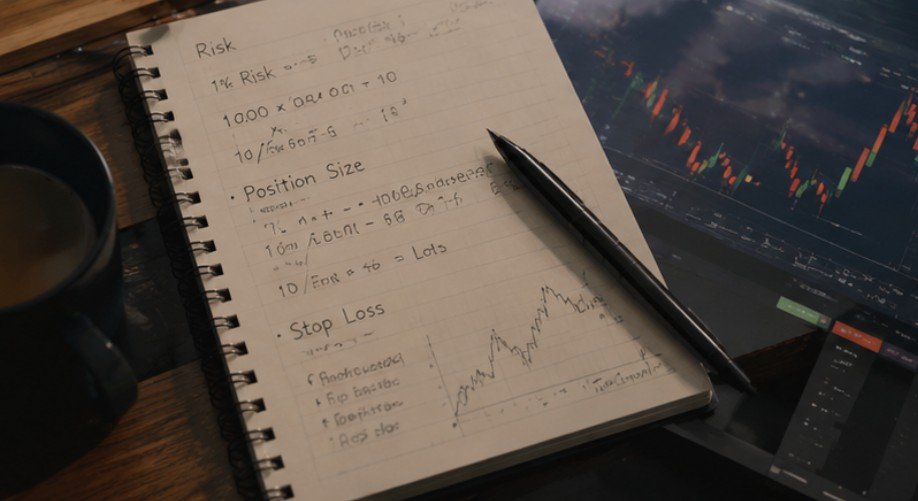
Proper forex trade sizing requires defining your account balance, choosing a strict risk percentage (usually 1–2%), and measuring your stop-loss distance. Compute your position using the formula: Lot Size = (Account Balance × Risk Percentage) / (Stop Loss in Pips × Pip Value).
Standard Account Worked Example
Applying this formula to a standard account scenario provides clear baseline mechanics. Imagine holding a $10,000 USD account balance, risking 1% ($100 risk amount) on EUR/USD with a 50-pip stop loss.
Multiplying 50 pips by the $10 standard lot pip value yields $500 risk per standard lot. Dividing $100 total risk by $500 yields a proper position size of exactly 0.20 lots or two mini lots.
Small Account Worked Example
Managing smaller capital pools demands precise fractional lot sizing. For a $500 USD account balance risking 1% ($5 risk amount) with a 25-pip stop loss on GBP/USD ($10 per pip standard rate), the formula divides $5 by $250. The resulting trade volume measures 0.02 lots or two micro lots, securing exact risk compliance.
Adjusting Volume For Cross Currency Pairs
Trading pairs without your account base currency as the quote currency introduces secondary conversion steps.
Handling Non-USD Quote Currencies
Calculating pip value changes when trading pairs like EUR/GBP or AUD/NZD with a USD account balance. The base pip value calculates in the quote currency before converting back to account funds. For example, 1 pip on a standard lot of EUR/GBP equals 10 British Pounds, requiring conversion to USD at current exchange rates to establish true monetary risk.
Cross-Currency Conversion Step-By-Step
Solving cross-pair sizing requires multiplying standard pip value by the conversion rate. If GBP/USD trades at 1.2500, a 10 Pound pip value converts to $12.50 USD per pip for standard lots. Plug this adjusted $12.50 value directly into the position size formula denominator to prevent accidental over-leveraging.
Volatility Adaptation Using Average True Range
Adapting position size to changing market volatility separates novice retail traders from disciplined market professionals.
Why Static Stop Distances Fail
Static stop losses often fail when market conditions shift from quiet consolidation to rapid expansion. Setting a strict 30-pip stop during high-impact news releases or structural market shifts usually causes premature stop-outs from noise rather than invalid setups.
Implementing ATR Volatility Multipliers
Using Average True Range grounds stop distances in live market behavior. Calculating stop loss distance as 1.5x or 2x the 14-period ATR indicator expands stop pips during volatile conditions and tightens them during calm setups. As ATR expands stop distance, the position size formula automatically reduces lot size, keeping total monetary risk perfectly stable.
Step-By-Step Guide: How To Size Forex Trades Properly

Executing accurate position sizing under live market conditions requires a repeatable operational routine.
Identify technical entry and stop loss levels on chart structures prior to opening order tickets. Measure exact pip distance from planned entry price down to the stop loss level.
Determine maximum allowable loss by multiplying total account equity by your target risk percentage, such as a $5,000 balance multiplied by 1% to get $50 risk.
Check account currency against the traded pair quote currency and calculate current pip value per standard lot, adjusting for current conversion rates if dealing with non-USD quote pairs.
Run numbers through the position size formula to find final lot volume, rounding figures down to the nearest available broker increment like 0.14 lots to maintain strict risk limits.
Input precise lot volume and stop loss orders into your trading platform execution window before placing the live trade.
Accounting For Execution Costs And Spreads
Real-world execution costs alter true trade risk beyond basic formula calculations. Understanding what is the interbank forex market and how does it work helps explain where currency prices and spreads originate.
Major banks and financial institutions exchange currencies through this decentralized global network, creating the liquidity that retail brokers use to quote tradable bid and ask prices.
When interbank liquidity decreases during volatile events or quieter sessions, spreads may widen and increase the true cost and risk of a position.
Incorporating Spreads Into Stop Distances
Bid-ask spreads add immediate cost upon trade execution. Adding current spread width like 1.5 pips on EUR/USD directly to target stop loss distance ensures trade management reflects total actual downside exposure.
Factoring Fixed Broker Commissions
Raw spread broker accounts charge fixed round-turn commissions per standard lot traded. Subtract estimated commission charges from total dollar risk amount prior to running lot calculations so total account drawdown remains capped at your exact target percentage.
Frequently Asked Questions
1. What lot size is good for $10,000 forex?
A 0.20 lot size works well for a $10,000 account balance risking 1% ($100) with a 50-pip stop loss on major USD pairs. Lot size always varies based on your exact stop loss distance.
2. What is the 3-5-7 rule in forex?
The 3-5-7 rule suggests risking no more than 3% on a single trade, 5% across all open trades simultaneously, and halting all trading if total account drawdown hits 7% in a single month.
3. How to position size in forex?
You calculate position size by multiplying account balance by risk percentage, then dividing that result by stop loss pips multiplied by pip value. Always determine stop loss distance before calculating final lot volume.
4. How to size forex trades properly on MetaTrader?
Knowing how to size forex trades properly on MetaTrader requires calculating your lot size using stop loss pips and account risk before entering your lot volume manually into the order box.
The Victory Lap of Mastering Forex Position Sizing
Consistent long-term trading success relies heavily on disciplined risk management rather than predicting future price movements. Calculating exact trade volume prevents individual losses from damaging long-term portfolio stability. Mastering how to size forex trades properly empowers traders to handle market volatility with total confidence, preserving precious trading capital through every market cycle.